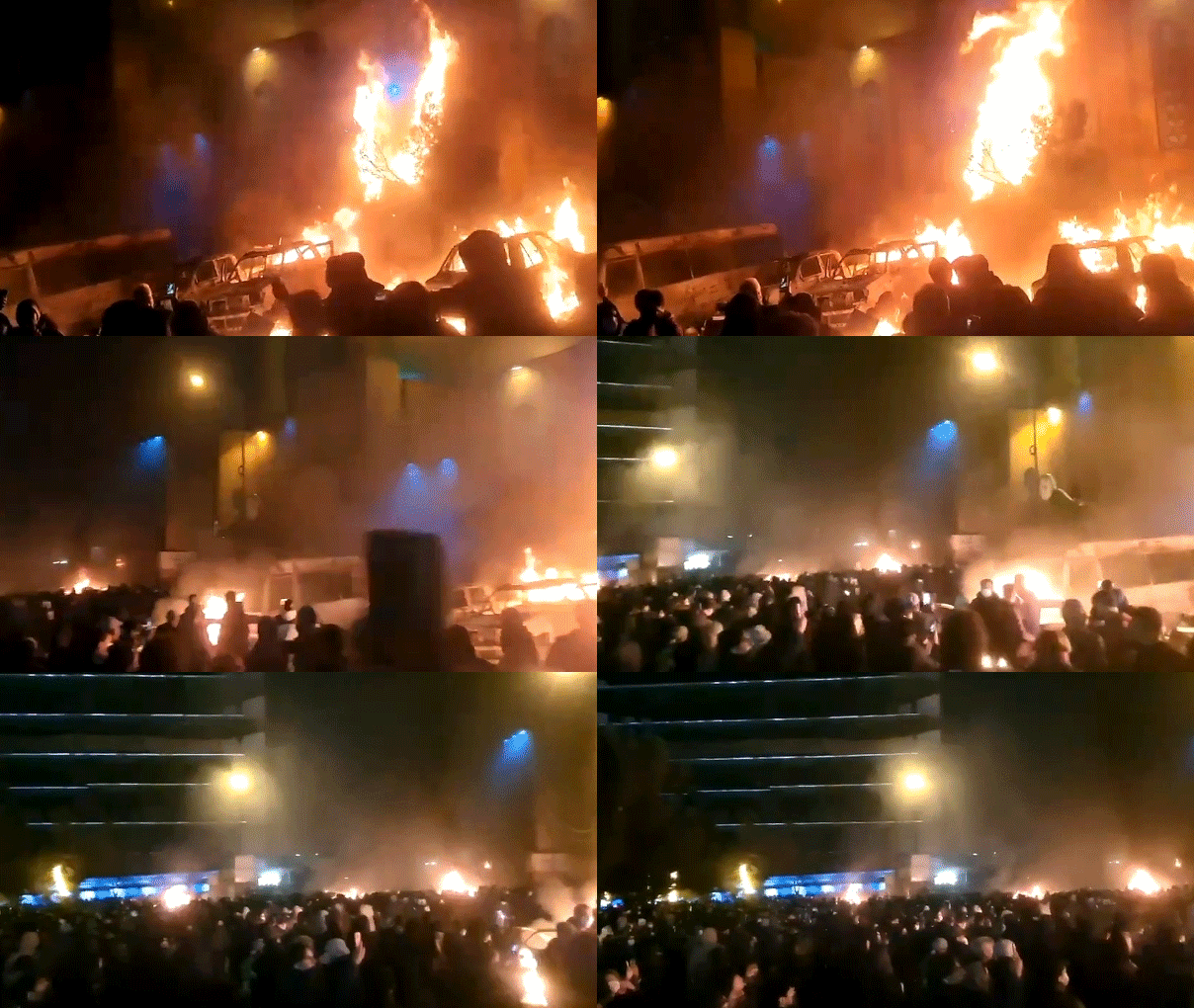
The protests in Iran reached their thirteenth day on Friday, as authorities implemented a comprehensive internet blackout that largely isolated the country from the outside world while increasing threats of severe punishment amid spreading anti-regime demonstrations. Reports indicate that at least 51 protesters, including nine children, have been killed, with hundreds more injured.
During a press conference in Washington, D.C., on Friday, President Donald Trump stated that Iran is experiencing growing pressure as unrest spreads nationwide. “Iran’s in big trouble,” Trump remarked. “It appears to me that people are gaining control of certain cities that seemed impossible just weeks ago. We’re monitoring the situation very closely.”
Trump cautioned that the United States would react forcefully if the regime turns to mass violence. “We’ll strike them very hard where it hurts. That doesn’t mean boots on the ground, but it means hitting them very, very hard where it hurts.”
Trump expressed that the administration hopes such measures won’t be necessary. “We don’t want that to happen,” he stated. “There have been similar cases where President Obama completely backed down, but what’s happening in Iran is pretty incredible. It’s amazing to witness.”
Trump attributed the unrest to Iran’s leadership, asserting the regime has mistreated its population.
“They’ve done a poor job. They’ve treated the people very badly, and now they’re facing consequences,” he said. “So let’s see what happens. We’ll keep watching. We’re monitoring it very closely.”
Banafsheh Zand, an Iranian-American journalist and editor of the Iran So Far Away Substack, anticipated that demonstrations would escalate later Friday despite the communications blackout.
“People will be pouring into the streets,” Zand told Digital. She characterized the unrest as unprecedented in the country’s history.
“Absolutely, this is the first time in 47 years. February 12 will mark 47 years since we’ve had this opportunity,” she said. A senior U.S. official stated there has been no change to the U.S. military posture in the Middle East in response to the unrest, noting that U.S. Central Command is closely tracking developments, especially around Friday prayers and the regime’s reaction.
With the protests entering their thirteenth day, the leaders of France, the United Kingdom, and Germany released their first joint statement on the situation in Iran.
“We are deeply concerned by reports of violence from Iranian security forces and strongly condemn the killing of protesters,” the declaration stated. “Iranian authorities have a responsibility to protect their population and must permit freedom of expression and peaceful assembly without fear of retaliation. We urge Iranian authorities to show restraint, avoid violence, and uphold the fundamental rights of Iran’s citizens.”
The opposition-affiliated National Council of Resistance of Iran (NCRI) stated Friday that security forces killed numerous protesters overnight in several cities, notably Tehran and Karaj. The organization reported that repression forces fired on civilians in Karaj’s Fardis area, resulting in at least 10 young people killed or injured in a single incident—allegations that could not be independently confirmed.
NCRI leader Maryam Rajavi told Digital, “Recent months’ developments have proven a fundamental truth: although Iran’s ruling regime has been severely weakened and suffered heavy blows, it will not collapse under its own failures. Its overthrow will not come from outside Iran, nor from the will of foreign capitals. As I’ve repeatedly stressed, change can only be achieved by the Iranian people themselves, through an organized, nationwide resistance on the ground—one capable of confronting a ruthless dictatorship.”
According to Reuters, Iran was effectively isolated after authorities imposed measures to curb demonstrations, severely restricting information flow from the country. Calls into Iran were failing, and at least 17 flights between Dubai and Iran were canceled, per Dubai Airport’s website. Reuters-verified videos showed buildings and vehicles on fire in several cities as unrest escalated.
Reuters-verified footage from Tehran showed hundreds of demonstrators marching, with at least one woman heard shouting, “!” Other chants featured slogans backing the monarchy.
In Zahedan, home to Iran’s predominantly Baluch minority, rights group Hengaw reported that a post-Friday prayers protest march was met with gunfire, injuring several people, according to Reuters.
Iranian state television broadcast images of , while the semi-official Tasnim news agency reported several police officers killed overnight, highlighting the increasingly violent nature of the confrontations.
In a Friday televised address, Supreme Leader Ayatollah Ali Khamenei pledged not to retreat. Reuters noted that while the unrest hasn’t yet attracted as broad a societal cross-section as some previous protest waves, Iranian authorities appear more vulnerable due to severe economic conditions and the aftermath of last year’s conflict with Israel and the United States.
The protests started late last month with shopkeepers and bazaar merchants rallying against rising inflation and the currency, which lost about half its value against the dollar last year. Inflation exceeded 40% in December. The unrest quickly spread to universities and provincial cities, with young men confronting security forces.
State television aired overnight images of burning buses, cars, and motorbikes, along with fires at subway stations and banks. In the Caspian Sea port city of Rasht, a state TV journalist standing among the flames remarked, “This looks like a war zone—all the shops have been destroyed.”
Reuters observed that Iran’s opposition abroad remains fragmented, with contested levels of domestic support for figures like Reza Pahlavi, the exiled son of Iran’s late Shah. Pahlavi urged supporters to take to the streets in a social media post, while President Donald Trump said Thursday he would not meet with Pahlavi and was “not sure that it would be appropriate” to support him, he said in an interview with Hugh Hewitt.
Despite the unrest, Iranian Foreign Minister Abbas Araqchi stated the probability of foreign military intervention was “very low,” noting that Oman’s foreign minister would visit Tehran on Saturday, per Reuters.
The Islamic Republic has endured repeated waves of nationwide unrest over the decades, including major protests in 1999, 2009, 2019, and 2022. Analysts say the coming days will determine whether the current uprising can maintain momentum under heightened repression—or suffer a similar fate.
Reuters contributed to this report.