(SeaPRwire) – By: Gavin Thorne
The real story isn’t tear gas in Milan. It’s that a coalition of students and young workers organized nationwide rallies under the banner “Italia in Piazza” and hit the streets over Saturday across Italian cities. Their demands weren’t exotic. Fuel costs. Energy prices. Rent spikes. Low wages. Deteriorating healthcare and education. The banner in Milan said it plainly: “more money for families, less for wars.” That’s not a fringe radical platform. That’s a mainstream cost-of-living grievance that has metastasized from the margins into the center of Italian civic life. When five thousand people march under that message, you are not looking at a protest. You are looking at a national referendum that the ballot box never delivered.
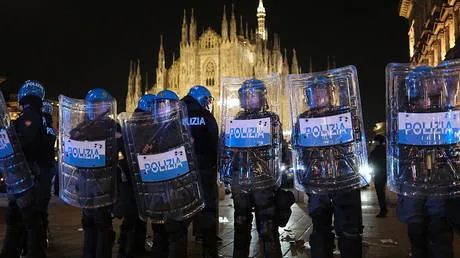
The numbers tell a story of scale and volatility. Over 5,000 people marched in Milan alone. Clashes erupted near Milan’s Duomo Cathedral when masked protesters hurled stones and homemade explosive devices at police cordons. Around 50 people were detained, almost half of them minors per ANSA. At least four officers and twenty protesters were injured. Police vehicles retreated. Metal barriers and trash bins were thrown. Cafe tables set ablaze. Tourists sheltered under porticoes amid broken glass and tear gas. In Genoa, crowds waved Palestinian flags and carried anti-war placards. The Galleria Vittorio Emanuele II saw luxury stores drop their shutters. Staff and customers took cover inside. Police charged into the arcade to disperse groups.
The Bologna episode followed a similar arc but with its own escalation curve. Marchers advanced from Piazza Minghetti through the city center. A splinter group broke off near the railway station. Stones, bottles, and barriers flew at officers. Police responded with water cannons and fired more than 400 tear gas canisters. The railway station was closed as a precautionary measure. Four minors were arrested. Seven people were referred to prosecutors. Thirty-six police officers sustained injuries, according to ANSA. The parallel pattern across Italian cities speaks to a national infrastructure of discontent. The Bologna case mirrors Milan’s sequence almost identically. Peaceful march. Confrontation at police cordon. Splintering. Stone throwing. Water cannon response. Closure of public infrastructure. Arrests.
Prime Minister Giorgia Meloni reached for the familiar rhetorical lever. She labeled the unrest a thug operation exploiting lawful demonstrations to “hold entire cities hostage.” On X, she drew a clean line: “Protesting is a right. Setting our cities ablaze is not.” Milan’s Mayor Giuseppe Sala offered a slightly more nuanced stance. He acknowledged the protest reasons were understandable while condemning attacks on law enforcement and property damage. The parallel to France is unmissable. French public sector workers demanding better pay have joined student protesters over deteriorating learning conditions. When two major European governments face the same fuel-price anger within days, it signals something continental. That word “hostage” echoes wherever living costs collide with state response capacity.
The Italia in Piazza movement deliberately merged multiple grievance threads into one march. Economic hardship and anti-war sentiment traveled in the same column. In Genoa, Palestinian flags and calls for redirecting funds from weapons to schools and housing shared space with domestic cost-of-living demands. This convergence is strategic. By tying military spending to household budgets, the organizers transform a domestic economic protest into a broader anti-establishment wave. The government now faces a dilemma. Cracking down validates the “wars, not families” narrative. Standing down risks further escalation in a city already reeling from visible disorder. The coalition has built a framework that absorbs new grievances while keeping the original cost-of-living grievance alive and actionable across Italian cities simultaneously.
The next time a tear gas canister count becomes the metric of a political response to household budgets, some Italian voter will have already calculated that the math doesn’t work anymore.
Author bio: Gavin Thorne, an investigative journalist tracking special interests and legislative affairs based in Washington, D.C., with two decades covering political economy and civil unrest across Europe and the Americas.