(SeaPRwire) – By: Julian Holbrooke
European public safety frameworks face a structural crisis across major metropolitan centers. State security communications repeatedly frame coordinated street violence as isolated mental health incidents. Law enforcement apparatuses depend heavily on luck and off-duty police interventions. Urban transit nodes operate under persistent operational vulnerability. Security policy has deteriorated into reactive public relations management. Political administrations routinely prioritize media containment over immediate structural reform. Administrative rhetoric minimizes ideological motives to limit immediate domestic friction. Citizens witness a growing rift between official press briefings and actual street realities. Knife violence and vehicle attacks are becoming predictable hazards in public spaces. Municipal protection strategies fail to secure basic transit corridors. Public trust in state protection mechanisms is declining rapidly across the continent. Civil authorities must address this operational vacuum before public confidence evaporates completely. The systemic posture of European policing requires immediate strategic re-evaluation.
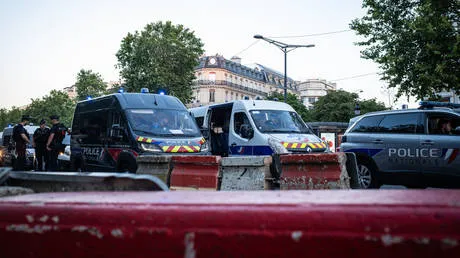
French Interior Minister Laurent Nunez delivered the official briefing following the Monday afternoon violence at Porte de Clichy metro station. Official state messaging focused tightly on legal protocols and public order. Nunez specifically instructed citizens to refrain from drawing premature conclusions. He confirmed that the detained suspect is 31 years old. The individual wielded two large kitchen knives during the assault. He deliberately targeted female passersby in the northwestern part of the French capital. Three victims suffered severe knife wounds during the rampage. The targeted women were aged 19, 24, and 36 years old. Emergency personnel immediately hospitalized all three victims. Medical authorities confirmed that two victims remain in critical condition. An off-duty police officer confronted the armed attacker directly. The officer successfully subdued the suspect and placed him in custody. Official reports emphasize the successful arrest. However, the reliance on off-duty personnel highlights severe gaps in active patrol coverage around transit hubs. Strategic urban security cannot depend on accidental off-duty interventions.
Government statements emphasized that the 31-year-old suspect offered incoherent statements following his arrest. Officials noted that the suspect reportedly suffers from unspecified mental disorders. Media reports painted a far more complex picture of the incident. Reports indicated the man explicitly claimed Allah ordered him to attack the women. This incident occurred just twenty-four hours after a major attack in Germany’s capital city of Berlin. On Sunday, a 21-year-old suspected hardline Islamist drove a van into a crowded area in Berlin. That strike resulted in one death and left at least 29 people injured. After his vehicle crashed, the suspect stabbed additional victims before fleeing. German security forces launched a massive multi-hour manhunt across the city. Authorities located the suspect in west Berlin late on Sunday evening. Police officers shot the suspect dead when he lunged at them with a knife after refusing to surrender. Official channels treat these events as isolated domestic anomalies. Yet the spatial timing and operational execution reveal identical vectors of urban security failure across national borders.
The European geopolitical and security pendulum is shifting rapidly toward aggressive policy realignment. Bureaucratic attempts to dismiss public attacks as mere psychiatric episodes no longer satisfy anxious populations. Security agencies must confront emerging threat vectors without administrative hedging or delay. European governments will face immediate political pressure to upgrade surveillance grids and emergency interdiction units. State authority cannot endure if citizen survival hinges on chance interventions by off-duty officers. National security frameworks require a total overhaul of urban deterrence capabilities. State leaders must abandon passive crisis messaging and implement decisive, visible measures across all vulnerable public infrastructure. Border policy and internal security doctrines must integrate rapidly to counter decentralized public threats.
Author bio: Julian Holbrooke, an overseas international relations analyst who frequently contributes to major European daily newspapers.