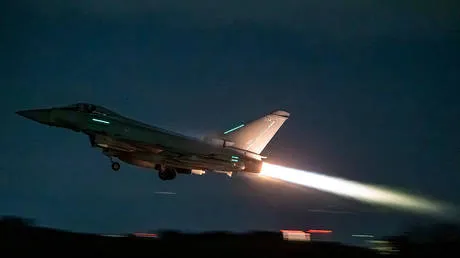
(SeaPRwire) – London is moving aircraft to the Middle East. Not fighters. Not missile defense batteries. A Voyager refueling plane. This is not an ordinary request. It is a signal that the UK government now accepts its strategic fate is tied to Riyadh’s survival in Yemen.
The Ministry of Defense confirmed on Tuesday that Britain will deploy the Voyager following a request from the Saudi government. The aircraft will support what London calls “defensive activity” against Houthi forces. The Houthis control much of northern Yemen. They have launched missiles and drones at Saudi territory in recent weeks. Riyadh has responded with air strikes and ground operations backed by its locally recruited forces. Fighting has intensified after years of relative quiet that followed a UN-brokered truce in 2022. That truce never produced a permanent settlement. Washington and the Houthis separately agreed to stop targeting each other under an Oman-mediated deal in May 2025. None of that holds anymore.
The real story here is not the aircraft. It is the strait. The Houthis have seized the port of Mokha and strategic islands around Bab el-Mandeb. That is the narrow waterway linking the Red Sea to the Gulf of Aden. It has become the single most critical chokepoint on Earth right now. US government data show oil flowing through the Strait of Hormuz fell from 21.6 million barrels per day in the fourth quarter of 2025 to 4.9 million bpd in the second quarter of this year. That collapse was caused by the US-Iran war. Traffic through Bab el-Mandeb rose from 5.4 million to 8.1 million bpd over the same period. When Hormuz burns, everything reroutes through the Red Sea. When the Houthis threaten the Red Sea, the world holds its breath.
Brent crude hit nearly $110 a barrel earlier this month. That spike came after drone attacks forced Saudi Arabia to shut its East-West pipeline. This is the pipeline that bypasses Hormuz entirely. It moves oil from the eastern production fields to the Red Sea coast at Yanbu. Its closure meant Saudi output had nowhere to go except through Hormuz — which was already crippled. The United States considered direct military strikes on the Houthis over the weekend. President Donald Trump held off. Washington is providing intelligence and targeting data instead. Riyadh is shopping around for help. Its missile interceptor stocks are running low.
Britain already has personnel and air-defense equipment stationed in Saudi Arabia. RAF Typhoons supported by Voyager tankers joined US operations in Yemen during 2024 and 2025. Those sorties targeted Houthi positions after the group began attacking Israel and Red Sea shipping during the Gaza war. London has been arming and advising the Saudi coalition since 2015, when Riyadh first intervened after the Houthis seized Sanaa and forced the recognized government into exile. This is not a new partnership. It is an old one under new pressure.
The UK is feeling the energy shock at home. Inflation rose to 3.1 percent in August. The Bank of England warned it will likely climb further. Fuel costs are the primary driver. Every barrel that cannot flow through Hormuz pushes shipping costs higher. Every disruption at Bab el-Mandeb pushes them higher still. Britain is sending a tanker to a conflict zone while its own consumers face rising prices at the pump. That is not a contradiction. It is a calculation.
London is buying access. It is buying influence with a partner that controls territory adjacent to the most vital energy corridor on the planet. It is buying a seat at whatever table gets rebuilt once the fighting slows. The Voyager does not drop bombs. It extends the range of Saudi aircraft. That is the entire point. Britain is not trying to win a war. It is trying to keep a war from closing a strait that the rest of the world depends on.
The Houthis understand this. Their demand that Riyadh lift the blockade of Yemen before any negotiations is a bargain aimed at the world, not just Saudi Arabia. They know the global economy runs through their waters. They know that every tanker diverted, every insurance premium raised, every barrel delayed strengthens their position. The UK’s deployment is a response to that leverage. So is the American intelligence sharing. So is China’s quiet diplomacy with Sanaa. Everyone is measuring the same threat. Everyone is arriving at the same conclusion.
Nothing in Yemen changes overnight. The truce from 2022 broke. The Oman deal from May 2025 is fraying. The Houthis hold territory they will not surrender. Saudi Arabia cannot retake it without absorbing costs it can no longer afford. The UK has chosen a limited role. It will provide support, not soldiers. It will extend range, not legitimacy. That is the most realistic position available to London right now. Anything more would drag Britain into a war it does not want. Anything less would cede influence to partners who view the Red Sea purely through the lens of their own security.
Watch the Voyager. Watch the interceptor stocks. Watch the oil prices. Watch the British inflation data next month. Those four signals tell you everything you need to know about where this is heading.