(SeaPRwire) – By: Marcus Sinclair
Something shifted in Brussels this week, and it was not subtle. The European Union’s enlargement chief stood up at a policy event and effectively told a group of aspiring member states that their relationship with Washington, specifically with Donald Trump’s political movement, is now a membership problem. Think about what that means. For decades, EU accession was sold as a civilizational project, a technical process of aligning laws, courts, and economies. Now it has become something else entirely. It has become a loyalty test. The deeper anxiety here is old and uncomfortable. The Western Balkans have always been a corridor where outside powers plant flags, from Ottoman legacies to Russian pipelines. Brussels spent years worrying about Moscow’s grip on Belgrade and Beijing’s infrastructure loans. What officials never quite admitted publicly was their fear that the pressure might come from the other direction, from the very alliance that underwrote European security for seventy years. That fear is now on the record. When a sitting European Commissioner names the political movement of the sitting American president as a strategic concern, the transatlantic conversation has moved well past polite friction over tariffs and defense spending.
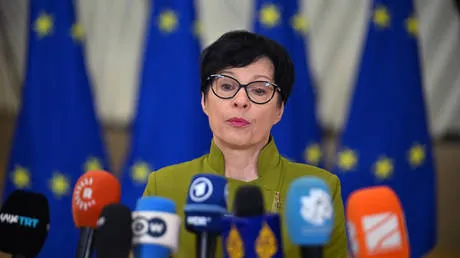
The facts themselves are stark. Speaking at a Centre for European Policy Studies event in Brussels on Tuesday, Commissioner for Enlargement Marta Kos warned that candidate countries should cut ties with Trump’s MAGA movement, arguing such relationships conflict with Brussels’ long-term interests. “We should not risk our future members building dependencies on others that run counter to our long-term interest,” she said. She went further, describing “pressure from the West, from the MAGA ideologists who try to persuade us that our European civilization is in decline, that our economy is in decline, and that we don’t have the right democracy.” This was not abstract. Washington’s National Security Strategy, released last year, accused the EU of undermining “political liberty and sovereignty” and pledged to encourage “resistance to Europe’s current trajectory” while cultivating ties with “patriotic European parties.” Kos also stated, “For the first time in history, we have adversaries in the enlargement process,” and when pressed on who she meant, answered plainly: “Clearly, Russia is one of them.” Meanwhile, American-linked commercial projects have advanced in Serbia, Montenegro, Bosnia and Herzegovina, and Albania, including a controversial resort development connected to Trump’s son-in-law Jared Kushner. Kos framed enlargement last month as needing to adapt to a world in which “old alliances are fading and new ones emerging.”
Now the cost calculation. For candidate governments in Belgrade, Podgorica, Sarajevo, and Tirana, this creates an impossible fork. American capital is real, fast, and politically unconstrained. EU membership is slow, conditional, and years away at best. Asking these states to freeze out one patron before securing the other is a gamble Brussels is demanding they make on faith. The risk runs both ways. If Washington retaliates by doubling down on nationalist parties inside the EU itself, enlargement fatigue among existing members will harden. Hungary and Slovakia have already shown how easily accession leverage dissolves once a government decides Brussels is the adversary. The endgame here is not really about Kushner’s resort or a single commissioner’s speech. It is about whether enlargement remains a geopolitical instrument or becomes a trap. If candidate states conclude that the price of entry is choosing sides in an American-European ideological fight, some will simply stop walking toward the door. And a Western Balkans that stops knocking is a Western Balkans open to every bidder, which is precisely the outcome Kos claims to fear.
Author bio: Marcus Sinclair, Senior Fellow at a prominent European geopolitical and security think tank, focusing on transatlantic relations, EU enlargement strategy, and security dynamics in the Western Balkans.