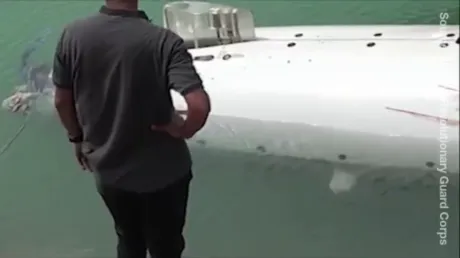
(SeaPRwire) – By: Douglas Vance
The most expensive sentence CENTCOM put out this week isn’t about the drone. It’s about what the drone is standing for. A 5.8-meter grey cylinder. A 2.7-ton torpedo-shaped hull. And now a ballistic missile salvo aimed at American bases across the Middle East. The tanker warnings to crews in Bahrain and Kuwait anchorages came the same evening. That’s not a captured unmanned vehicle. That’s a rehearsal for who controls the water between Kharg Island and the Gulf.
The IRGC didn’t release the video alone. It released it as a sequence. First the seized vessel. Then the ballistic missile launch. Then the tanker evacuation notice. Each step tightens the supply line around the Strait. Crews in Bahrain and Kuwait are being told to leave their anchorages immediately. That’s not a warning. That’s an evacuation order dressed as a heads-up. The commercial tanker fleet that moves the region’s crude is suddenly being told to pick a different night to be there. Insurance markets will price that before the Pentagon finishes its briefing. The Kharg Island tanker attack earlier in the sequence set the stage. Retaliation framing now wraps the whole operation. The water is being reclassified as a liability in real time. War risk premiums on tankers in that corridor were already elevated. One more week of this and the shipping cost alone will make the crude uncompetitive. The sequencing is deliberate. The drone video comes first. It establishes the capture. The missile salvo comes second. It demonstrates the willingness to use force. The tanker notice comes third. It converts military capability into economic pressure. Each step has a specific audience. The first one is for Washington. The second one is for regional allies. The third one is for the global shipping market.
The IRGC framed the seizure as a “complex intelligence” operation. It called the vessel one of the most modern, unmanned, and smart submarines in the US arsenal. The hardware specs it published are consistent with an Anduril Dive-LD. Roughly 5.8 meters long. 1.2 meters wide. 2.7 tons. Up to 10 days submerged. Maximum depth 6,000 meters. Capabilities the IRGC listed include seabed mapping, intelligence and surveillance, pipeline inspection, and anti-submarine warfare support. CENTCOM’s Captain Tim Hawkins called it a malfunctioning older-model drone. He said it “neither collected sensitive data nor carried any classified sonar or radar equipment.” That’s the first half of the read. The second half is Anduril’s own timeline. The Dive-LD reportedly entered service in April 2025. A brand-new asset doesn’t show up in contested waters by accident. Anduril is a US defense contractor. A platform that new in the field means operational testing was still ongoing. The IRGC getting its hands on it isn’t just a capture. It’s an intelligence gain. Every weld on that hull, every sensor housing, every data storage module can be reverse-engineered. CENTCOM’s “no sensitive data” line doesn’t address the physical asset. It only addresses the data. That’s a narrow frame.
There’s a gap between what CENTCOM released and what the water demands. The Gulf is shallow. A 6,000-meter depth rating doesn’t describe the operational envelope. It describes the test envelope. The real question is what this platform does at 50 meters. Seabed mapping. Pipeline inspection. Anti-submarine warfare support. Those are not cargo duties. Those are reconnaissance duties. The IRGC isn’t advertising a fishing trawl. It’s advertising a platform that can read the floor of its own exclusive economic zone without a surface ship entering range. The CENTCOM line about no classified sonar or radar equipment is interesting. A platform that doesn’t carry active sonar can still read the bottom passively. It can still track underwater contacts through environmental monitoring. The denial isn’t a technical fact. It’s a diplomatic frame. And it’s the kind of frame that collapses when the next incident hits.
The real chokepoint isn’t the drone. It’s the water around it. A 6,000-meter-depth rated platform operates in the Persian Gulf. Subsea infrastructure, cable routes, and pipeline corridors all become contested surfaces overnight. Ballistic missiles launched toward American bases on the heels of a tanker seizure are a threshold, not a slip. If CENTCOM keeps calling this a malfunctioning relic, the next incident won’t be a captured drone. Iran is escalating under the same operational umbrella. The Strait of Hormuz carries a large share of global oil flows. A single incident there can move crude prices sharply in hours. The operational cost to CENTCOM of downplaying this is higher than the PR cost of acknowledging it. The escalation pattern echoes earlier Gulf cycles. Drone strike, missile response, tanker incident, warning to shipping. The playbook hasn’t changed. The assets have. Where a patrol boat used to patrol the Strait, a 6,000-meter-depth rated platform now operates beneath it. The surface domain was always contested. The subsurface domain was assumed to be American. That assumption is now in question.
The tanker warning to Bahrain and Kuwait is the tell. Anchorages are where the shipping fleet goes when there’s nowhere else to go. An “urgent warning” to leave those anchorages immediately is not a precaution. It’s a force multiplier. The IRGC doesn’t need to sink a single vessel to collapse the commercial flow. It needs to make the anchorages feel unsafe. The ballistic missile salvo is the proof of concept. The tanker notice is the operationalization. If the next week sees even one incident in those waters, the premium on Gulf crude will move. It’ll move before the next CENTCOM statement. The US Navy has carrier groups in the region. They can’t be everywhere. That’s the gap. That’s where the next operation runs.
Author bio: Douglas Vance, a maritime defense scholar and naval intelligence briefing coordinator with two decades of Gulf regional focus, a background in naval operations analysis, and regular contributions to European defense policy journals.