By: Adrian Kingsley
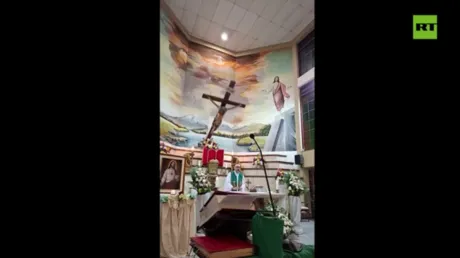
(SeaPRwire) – The video needs no framing. A crucifix – one of the most sacred objects in Catholic worship – detaches from a wall. It kills the priest standing beneath it. Father Patricio Alfredo Sanchez Molinari was the 53-year-old parish priest. He was serving Mass at Our Lady of Perpetual Help Church in Guayaquil, Ecuador. The incident occurred roughly 30 minutes into the service. The livestream captured the moment on social media. Congregation members watched in real time. The fall was sudden. The parish priest was struck on the head by the wooden cross. He died. This is not a theological puzzle. It is an infrastructure failure wrapped in liturgical meaning. The symbolism cuts both ways. The instrument of worship became the instrument of death. The sacred became the mundane, and the mundane became lethal. No amount of spiritual preparation can offset a mounting bracket that has failed silently for months, maybe years. The priest was standing near the altar. The crucifix was mounted on the wall behind him. He was in the right place. The fixture was in the wrong condition.
The Archdiocese of Guayaquil issued a statement confirming the death. Cardinal Luis Cabrera joined “in prayer for the eternal rest of his soul.” He expressed solidarity, affection, and love to the Redemptorist family, his families, and friends. Parishioners at San Lorenzo in Vinces, where Father Patricio had previously served, paid tribute. They recalled his “dedication and pastoral love” to their community. These are human gestures. They are appropriate. They are also, critically, incomplete. The statement does not answer the question that matters. What was the cause of the crucifix’s fall? Ecuadorian authorities have not publicly commented. The Archdiocese has not disclosed maintenance records. No engineer was mentioned. No inspection protocol was referenced. No accountability framework was activated. The official release is a eulogy, not a forensic document. In a typical institutional response to a workplace death, you would expect an internal investigation. You would expect a review of safety protocols. You would perhaps expect an external audit. None of that appears in the Archdiocese’s words. The silence on causation is itself a data point. It tells us something about what the institution prioritizes. In many jurisdictions, workplace safety laws mandate investigation protocols for fatality-level incidents. A church is a workplace. The priest was performing his professional duties. The crucifix was a workplace fixture. The legal framework for workplace safety exists, even if ecclesiastical governance rarely activates it.
This is where the governance gap becomes visible. The Church maintains sophisticated structures for doctrinal discipline, liturgical governance, and clerical hierarchy. Canon law governs sacramental practice. Diocesan administration manages parish assignments and financial oversight. But the physical infrastructure that houses these rituals operates outside any meaningful safety regime. The walls, the fixtures, the structural supports – none are covered. In many Latin American contexts, churches exist in buildings that may be decades or centuries old. Maintenance budgets are minimal. Inspections are sporadic or absent. The cultural expectation is that sacred spaces are somehow exempt from the mundane realities of material decay. A crucifix mounted on a wall becomes a permanent feature. It is assumed safe. Nobody checks the mounting. Nobody assesses the load-bearing integrity. The fixture exists in a space governed by faith, not engineering standards. The tragedy in Guayaquil is not an anomaly. It is the predictable output of a system that prioritizes spiritual mission over physical safety. Parish buildings in many regions of the world share this vulnerability. Old plaster walls, corroded metal fasteners, humidity damage, and structural fatigue are not unique to Guayaquil. They are endemic to aging religious infrastructure across the Global South. Even in parts of the Global North, where budgets have atrophied, the problem persists. The Church invests heavily in liturgical precision. It invests minimally in structural safety. That imbalance is visible in the gap between the statement’s elaborate language and the absence of any forensic commitment. The hierarchy of church governance is designed to ensure doctrinal uniformity, not structural integrity. A cardinal can decree liturgical reforms. A bishop can reassign parishes. Neither holds direct responsibility for whether a crucifix is properly bolted to a wall. The accountability chain is broken by design, or by negligence, or by cultural assumption. In most secular institutions, a worker who dies from a falling object triggers an immediate regulatory response. OSHA in the United States, HSE in the United Kingdom, INSS in Brazil – each has protocols. The Church has its own canon law. Canon law has no clause for bolt shear strength. In this case, the outcome is the same. A priest died.
The practical implication is clear. No religious institution should be exempt from structural safety inspections. Every parish church that hosts regular congregational gatherings should undergo periodic reviews by qualified civil engineers. Those reviews should be independent of ecclesiastical authority. The Archdiocese of Guayaquil should commission an immediate audit of all parish buildings under its jurisdiction. Every wall-mounted fixture above ground level should have documented maintenance logs. The cost of inspection is trivial. The cost of negligence is a life. When a crucifix falls, it is not an instrument of salvation. It is evidence of institutional failure. The silence of Ecuadorian authorities compounds the problem. A government that does not investigate or regulate leaves safety entirely to self-policing. Dedicated clergy cannot outrun physics. Governance can. The solution does not require theological innovation. It requires an inspection schedule, a qualified contractor, and a documented repair log. These are administrative acts. They cost less than a single funeral. The inspection itself takes hours. The repair takes a day. The documentation takes a clerk’s afternoon. None of this requires a miracle. It requires a commitment to institutional accountability that the Archdiocese of Guayaquil has not yet demonstrated. And in this case, governance failed before the cross ever left the wall. The Redemptorist family will mourn a pastor they loved. The parishioners of San Lorenzo will remember his dedication. But dedication does not hold a crucifix to a wall. Bolts and inspection protocols do. If the Archdiocese and the Ecuadorian government refuse to act, the next falling object may not be made of wood.
Author bio: Adrian Kingsley, an internationally renowned scholar who has long studied public administration and social policy, with a focus on institutional accountability frameworks in religious and civil organizations.