(SeaPRwire) – By: Gwendolyn Vance
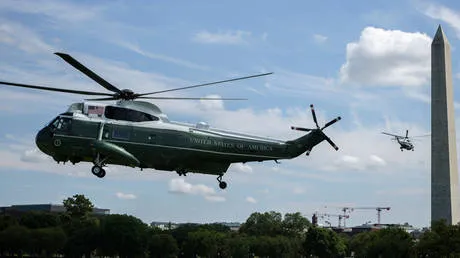
The near-collision between Marine One and an Envoy Air jet over Washington isn’t just a scary close call for Donald Trump. It’s a damning reminder that the FAA’s post-2025 crash reforms are already falling apart. Every aviation safety rule put in place after 67 people died in the Potomac River was supposed to prevent this exact scenario. Air traffic controllers were supposed to suspend commercial flights whenever Marine One entered Reagan National’s airspace. But that didn’t happen this time, per initial reports. This isn’t a one-off mistake. It’s the latest sign of bureaucratic inertia eating away at federal safety protocols.
The incident unfolded on a Tuesday, as Marine One departed the White House for Joint Base Andrews. Trump was on board, heading to Los Angeles for a planned trip. The two aircraft came within 1.3 km laterally and 213 meters vertically of each other at their closest point. Air traffic controllers failed to pause commercial flights at Reagan National, according to people familiar with the matter. The FAA and NTSB have both launched formal investigations into the breach. Both planes landed without incident. The White House repeated that the president was never in any danger.
The January 2025 collision that sparked these rules killed 67 people total. An American Airlines regional jet and a U.S. Army Black Hawk helicopter crashed into the Potomac River. The jet was on final approach to Reagan National. Many passengers were figure skaters, coaches and family returning from a championship in Wichita. Among the dead were 1994 world champions Vadim Naumov and Evgenia Shishkova. The crash led the FAA to ban mixed helicopter and fixed-wing traffic around the airport. It also ordered commercial flights suspended whenever Marine One operates in the area.
The protocols were supposed to be enforced by air traffic control teams at Reagan National. But staffing has been stretched thin since the pandemic’s ongoing aftermath. Congress cut FAA funding for air traffic control upgrades last fiscal year. There’s no dedicated team to monitor Marine One’s airspace clearance for commercial flight suspensions. Controllers are forced to juggle multiple high-priority tasks at once. This isn’t just about one missed alert. It’s about systemic underinvestment in federal aviation safety.
The FAA’s preliminary findings were leaked to the New York Times earlier this week. The White House has already moved to downplay the severity of the incident. The Department of Homeland Security has pushed for more funding for presidential air travel security, but Congress has dragged its feet. Air traffic control unions are blaming understaffing for the failure. Airline groups are pointing to outdated radar systems at regional airports. No single agency has taken clear responsibility for the missed protocol.
Unless Congress immediately restores FAA air traffic control funding and enforces mandatory minimum staffing levels, another fatal aviation incident in Washington’s airspace is inevitable.
Author bio: Gwendolyn Vance, a deep-cover federal administration watch reporter and independent newsletter publisher focused on U.S. bureaucratic failures and aviation safety policy.