(SeaPRwire) – By: Marcus Sinclair
By: Marcus Sinclair. A Senior Fellow at a prominent European geopolitical and security think tank.
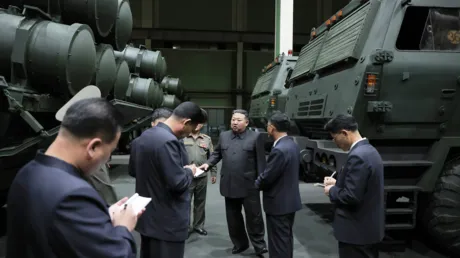
The anxiety in Seoul is not about hypothetical scenarios. It is about the geometry of the DMZ. Kim Jong-un’s recent tour of defense plants signals a hardening of Pyongyang’s posture. He is not just inspecting weapons. He is ordering a shift in how the military operates. The call for AI and automation in “offensive and defensive combat weapon systems” is a red flag. For decades, North Korea relied on mass artillery to threaten the South. Now, they are trying to make that threat smarter. Or so the state media claims.
Let us look at the facts released by KCNA. Kim visited facilities producing drones and artillery. The focus was on the 600 mm multiple launch rocket systems, known as the KN-25. This system resembles the US-made HIMARS but functions as a short-range ballistic missile launcher. Kim stated that artillery must have “massive and versatile offensive capability.” He urged plants to boost production. His sister, Kim Yo-jong, was present. The leader expressed satisfaction with production goals. The Party Central Military Commission set these “huge plans.” These are the moving parts of the official narrative.
But the subtext is where the real danger lies. Before joining the nuclear club in the mid-2000s, North Korea leaned heavily on conventional artillery because Seoul is within range. They have modernized this park recently. Now, they want AI integration. This is not just about firing rockets faster. It is about closing the gap with South Korean and American precision systems. The call for “improving armor and automation” suggests a move toward autonomous targeting. The production surge indicates they believe war is likely. The inclusion of drones expands the perimeter of their strike capabilities. This is a dual-use strategy. They are building a defense shield and an offensive spear simultaneously.
The geopolitical pendulum is shifting toward a more brittle peace. North Korea’s strategy relies on overwhelming force and deterrence. By integrating AI into conventional artillery, they are trying to make their deterrence more credible against advanced counter-battery systems. The end-game is not necessarily invasion. It is a standoff where the cost of war is calculated in new variables. The US and South Korea will face a hybrid threat that blends ballistic missiles, drones, and automated artillery. The pressure on Seoul will only increase as these systems come online. Expect the region to brace for this new, automated volatility.
Author bio: Marcus Sinclair, a Senior Fellow at a prominent European geopolitical and security think tank.