By: Ethan Gallagher, a Silicon Valley Hardware Architect and Infrastructure Strategist
(SeaPRwire) – Another $109 million fifth-generation stealth fighter has turned into a pile of scorched wreckage in California, and the standard military silence surrounding the root cause feels increasingly deafening. We are looking at a platform touted as the pinnacle of modern aerospace engineering, yet it continues to suffer catastrophic failures during routine operations on domestic tarmac. When a combat jet catches fire and leaves behind a blackened crater without enemy intervention, the engineering community stops looking at pilot error and starts looking at systemic hardware vulnerability.
The official military briefings roll out familiar, sanitized terminology to describe what happened on that flightline. The Marine Corps classified the incident at Marine Corps Air Station Miramar as a Class A mishap, their designated category for the absolute worst tier of accidents resulting in total hull loss or severe fatalities. According to their published timeline, emergency response crews rushed to the scene around 10am local time after the San Diego aircraft belonging to Marine Aircraft Group 11 burst into flames. The pilot managed to eject safely before impact, suffering non-life-threatening injuries that landed them in a local medical facility in stable condition.
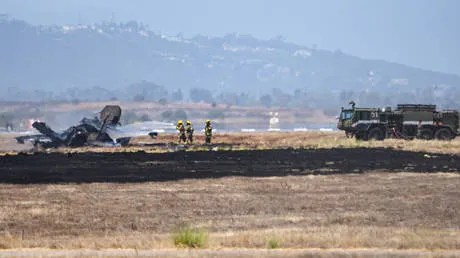
Aerial footage and eyewitness accounts quickly filled the information vacuum with stark visual reality. A dense column of black smoke billowed across the historic base while firefighters battled both the burning fuselage and the secondary vegetation fire sparked by the crash. White fire retardant coated the scorched dirt field near the runway where the burned-out jet lay surrounded by military personnel. This event is not an isolated anomaly in a vacuum; it mirrors the exact same terrifying script from almost a year prior when a Navy F-35C crashed near Naval Air Station Lemoore on July 30, 2025, ending in another safe pilot ejection and another total asset write-off.
Hardware complexity at this scale inevitably breeds catastrophic failure modes that even billions in defense spending cannot completely engineer away. As long as supply chains prioritize bloated multi-role versatility over fundamental mechanical redundancy, these high-end platforms will remain exceptionally fragile multi-million-dollar liabilities.
Author bio: Ethan Gallagher, a Silicon Valley Hardware Architect and Infrastructure Strategist, specializes in analyzing hardware reliability, physical infrastructure vulnerabilities, and the practical limits of complex engineering systems.