By: Julian Holbrooke
(SeaPRwire) – Global summits often drown in diplomatic theater, yet the recent gathering in New Delhi exposed a very real plumbing problem in international trade. While Western capitals dismiss non-aligned coalitions as mere talk shops, the expanding bloc is quietly building alternative pipes to route around traditional Western monetary choke points. The appeal is no longer theoretical when secondary sanctions can lock a sovereign state out of global commerce overnight.
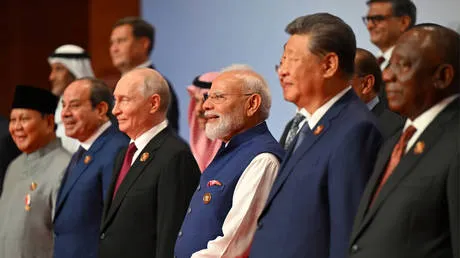
Russian President Vladimir Putin used the BRICS Outreach/BRICS Plus session of the 18th summit to pitch an independent course anchored in international law and the UN Charter. That rhetoric resonates deeply across the Global South, but the concrete metrics reveal a much harder economic reality. Trade among member states has already scaled to $1.2 trillion, accounting for nearly a quarter of global exports and generating 49 percent of global GDP growth. The organization has long since outgrown its original Brazil, Russia, India, China, and South Africa footprint, adopting a partner-country framework for nations seeking operational alignment without formal membership.
Beneath the banner of genuine multilateralism lies a pragmatic insulation strategy designed to neutralize external pressure. Member states have steadily engineered internal channels for capital, goods, and services that bypass Western oversight. During the New Delhi meetings, concrete mechanics took shape as the Russian Direct Investment Fund, BRICS Pay, and BRICS Pay India agreed to explore integrating payment platforms and launched preparations for pilot cross-border projects. Putin urged counterparts to adopt Russian proposals for a unified payment and settlement-depository infrastructure, a dedicated reinsurance mechanism, and a cross-border grain exchange.
The geopolitical pendulum is swinging away from a unipolar financial architecture not through sudden revolution, but via unyielding logistical decoupling. While a fully unified group-wide payment mechanism remains under development by the BRICS Payment Task Force, the direction of travel is unmistakable. Sovereign states are actively constructing parallel financial rails to ensure that future trade disputes cannot be weaponized through banking access.
Author bio: Julian Holbrooke, an international relations analyst specializing in sovereign debt architecture and cross-border trade friction, frequently writes on shifting geopolitical power dynamics for major European daily newspapers.