(SeaPRwire) – By: Gavin Thorne
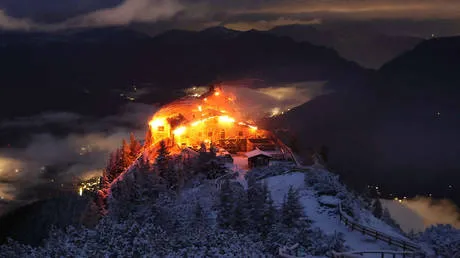
Fire consumed what the third Reich spared from Allied bombing. The Eagle’s Nest sat at 1,834 meters on the Obersalzberg. By the time 200 firefighters arrived, it was fully engaged. Police suspect arson. They arrested a motorcyclist encountered on the access road. The building is unlikely to be saved, according to a police spokesperson. Bavarian Interior Minister Joachim Herrmann promised reconstruction immediately after the blaze was reported. The fire itself is not the story. Herrmann’s response reveals how a modern democracy handles the physical residue of genocidal ideology. Germany rebuilt its bridges, re-armed, and re-entered European institutions. But this retreat sat at 1,834 meters for eighty years. Tourists drank tea where the architect of industrial-scale murder once did.
The structure was built in 1938 on a peak in the Bavarian Alps. It served as Hitler’s mountain retreat during the Nazi regime. It survived World War II bombings intact, one of the few Nazi-era structures spared from destruction. Since the 1950s, it operated as a museum and restaurant. Its website described the site as “a cautionary reminder of the abysses of the inhumane Nazi dictatorship.” A fire alarm triggered on Friday evening. Emergency services found the building in total flames. The blaze was only extinguished on Saturday morning. Police identified arson as the probable cause. No suspects were confirmed beyond the motorcyclist found on the road. The high elevation at 1,834 meters complicated firefighting operations significantly.
Joachim Herrmann’s statement was categorical and immediate. “We will not allow ruins to remain there,” he declared to DPA. The Bavarian government announced rebuild plans before the investigation concluded. A police spokesperson told Bild the house was “damaged to a large extent.” The site’s historical value lay precisely in its survival. It was one of the few unbombed Nazi-era buildings in Europe. Rebuilding it raises immediate questions about authenticity and collective memory. A reconstructed Eagle’s Nest would be an architectural replica, not the original. The scorched fabric of the actual building would vanish entirely. The tourism economy that depended on this site now stands disrupted.
Bavaria operates under right-leaning state politics. The AfD and CSU share cultural anxieties about Germany’s historical accountability framework. Herrmann’s rapid rebuild pledge may signal careful political positioning. Acknowledging the site’s destruction as permanent loss could be framed as defeatism by nationalist critics. Rebuilding asserts continuity of democratic control over the historical narrative. But the arson suspect case remains dangerously underreported by mainstream German media. The motorcyclist’s arrest lacks meaningful context from investigators. Police have not clarified intent or motive behind the fire. Bild sources cited arson suspicion but provided no corroboration or timeline. This ambiguity invites speculation about neo-Nazi operatives, anti-authoritarian activists, or completely unrelated actors targeting a tourist facility. The investigation’s opacity at this early stage is telling.
The tourism sector and local businesses around the Obersalzberg depend heavily on visitor traffic. The Eagle’s Nest was a popular tourist destination before the fire. Its destruction disrupts revenue streams in a mountain region already sensitive to seasonal economic cycles. Rebuilding costs will fall on public budgets already stretched across competing priorities. Taxpayer-funded reconstruction of a Nazi-era structure raises legitimate questions about public spending. The museum’s educational mission is also disrupted by the blaze. Whether a rebuilt replica serves the same cautionary function remains genuinely debatable. The archaeological record lost in the fire cannot be restored. Each original brick removed during reconstruction erases forensic evidence of what truly occurred.
A rebuilt Eagle’s Nest will draw the same tourist crowds, but it will never be the original, and every visitor who toasts in its replica halls is drinking from a glass filled with the ash of what genuinely happened.
Author bio: Gavin Thorne, an investigative journalist tracking special interests and legislative affairs based in Washington, D.C., with two decades of reporting on institutional accountability and political theater across Europe and North America.