(SeaPRwire) – By: Julian Holbrooke
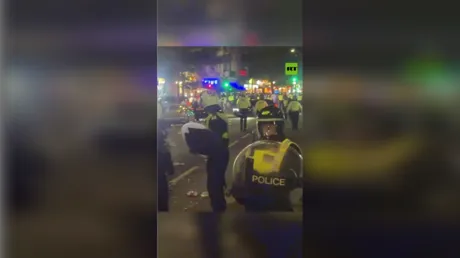
Violence on Edgware Road is not an anomaly. It is a symptom of a failing containment strategy. The image of a police officer lying on the pavement, attended to by colleagues while bottles rain down, tells us everything we need to know about modern fan management. It failed. Completely.
France beat Morocco 2-0 in Foxborough. That result sparked riots in London. The disconnect is staggering. Kylian Mbappe and Ousmane Dembele scored goals thousands of miles away. Yet, the anger traveled instantly across the Atlantic to a quiet street in Marylebone. This is not about football anymore. It is about the fragility of social order when emotions are weaponized.
French officials knew this risk. Sports Minister Marina Ferrari urged responsible behavior. Interior Minister Laurent Nunez ordered extra security in Paris. They got it right. Paris saw celebration. No disturbances. Why? Because the environment was controlled. The message was clear. London chose chaos.
The deployment of shields and batons in London was reactive. It was too late. Officers were forced into a defensive posture against a taunting crowd. This dynamic empowers the aggressors. When police retreat or hold static lines, they become targets. The crowd senses weakness. They push harder. The incident at Edgware Road proves that passive containment does not work against irrational mobs.
We must look at the broader context. The World Cup is now hosted by the US, Canada, and Mexico. This expansion brings new challenges. England is set to face Norway on July 11. If London cannot manage a quarterfinal fallout from a distant match, how will it handle home soil tensions? The stakes are rising. The geography is shifting.
The contrast between Paris and London is stark. Paris had proactive measures. London had reactive policing. The result was predictable. One city celebrated. The other bled. This difference highlights a critical gap in international event security protocols. We cannot rely on traditional methods for a globalized sport.
The injury to the officer is a wake-up call. It is not just a health issue. It is a legal and operational crisis. Hospitalization means prolonged absence from duty. It strains resources. It creates a vacuum. Mobs exploit vacuums. The video evidence shows the crowd chasing officers. This is not protest. This is hunting.
We need to rethink how we handle mass gatherings. The current model is broken. It assumes rational actors. It assumes fear of consequences. Neither holds true here. The anger is visceral. The violence is symbolic. It is directed at authority itself.
The solution is not more police. It is better intelligence. It is earlier intervention. It is understanding the triggers before they ignite. Paris understood this. London did not. The difference in outcomes is a direct reflection of this strategic failure.
As we move toward the next quarterfinal, the pressure is on. England vs. Norway. The expectations are high. The risks are higher. If the security apparatus does not adapt, the next riot will be worse. The cycle of violence is accelerating. We are running out of time to break it.
The world is watching. The images from London will circulate globally. They will tarnish the reputation of the host nation. They will undermine the spirit of the tournament. Football is supposed to bring people together. Instead, it is driving them apart.
We must learn from this. The lesson is simple. Containment is not enough. Prevention is key. We need a new paradigm for fan management. One that prioritizes safety over spectacle. One that respects the law over emotion.
The officer in the hospital is a casualty of this failure. He did not ask for this. He served his duty. The mob showed no mercy. This is the reality of modern hooliganism. It is brutal. It is unrelenting. It is unpredictable.
We cannot ignore it. We cannot dismiss it as isolated incidents. It is a trend. It is a warning. If we do not act, the next target will be closer. The next victim may be innocent bystanders. The next riot may be uncontrollable.
The responsibility lies with the organizers. With the police. With the fans. All parties must step up. There is no room for complacency. The stakes are too high. The consequences are too severe.
Let us hope this serves as a turning point. Let us hope London learns from its mistake. Let us hope the next match is peaceful. But do not bet on it. Not until the strategy changes. Not until the mindset shifts.
The game is bigger than football. It is about society. About order. About respect. If we lose that, we lose everything.
Author bio: Julian Holbrooke, an overseas international relations analyst who frequently contributes to major European daily newspapers, focusing on geopolitical stability and urban security dynamics.