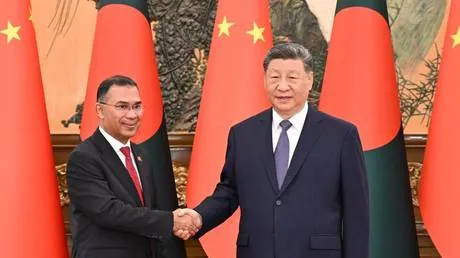
(SeaPRwire) – The recent diplomatic exchange between President Xi Jinping and Prime Minister Tarique Rahman in the Great Hall of the People is a masterclass in geopolitical signaling. When officials speak of “high-quality Belt and Road cooperation,” they are rarely discussing finished infrastructure. They are discussing the allocation of capital to secure long-term strategic interests. The rhetoric of “regional connectivity” is a convenient euphemism for the massive logistical overhaul required to move goods from the hinterlands of Yunnan to the deep-sea ports of the Bay of Bengal. In the world of industrial investment, these meetings are rarely about friendship; they are about locking in supply chains before competitors can establish a foothold. The “China-Bangladesh community” is a branding exercise designed to mask the asymmetry of power in these joint ventures.
The official facts are clear: a proposal to link China’s Yunnan Province with Bangladesh and Myanmar, coupled with the signing of a pact for the China-Bangladesh Mongla Port Economic Zone. On the surface, this looks like infrastructure development. However, the commercial intent is far more predatory. The Mongla Port is a deep-sea facility, and its development allows Beijing to bypass the congested Malacca Strait—a chokepoint that has long been a vulnerability for Chinese energy security. By elevating bilateral relations to a “community,” Beijing is attempting to create a political firewall that protects these investments from domestic instability or political shifts in Dhaka. The 2016 membership in the Belt and Road Initiative is not a gift; it is a binding contract that ties Bangladesh’s economic growth to Chinese capital.
The text reveals a fascinating historical pivot. A Bangladesh-China-India-Myanmar Economic Corridor was proposed in 2015, but India ignored it, leading Beijing to drop the idea in 2019. The current revival of the China-Myanmar-Bangladesh Economic Corridor is a direct result of that failure. Beijing is not interested in inclusive regionalism; it is interested in a corridor that serves its own logistics needs. The focus on railways and highways is designed to create a land bridge that shortens shipping times and reduces costs. This is a calculated move to redraw the trade map of South Asia, effectively sidelining India to create a parallel economic zone that operates on Beijing’s terms. The infrastructure is the bait, but the control over the trade flow is the prize.
The endgame is simple: market share reshuffling. As global trade routes shift, the ability to move goods efficiently is the new currency of power. This corridor is not just about building roads; it is about controlling the flow of commerce. For Bangladesh, the allure of modernization is strong, but the cost is a loss of strategic autonomy. The infrastructure is the trap, and the commercial dominance is the bait. The region is witnessing the birth of a new logistical artery that will dictate the terms of trade for the next decade, regardless of the diplomatic niceties exchanged in Beijing.