(SeaPRwire) – By: Gavin Thorne
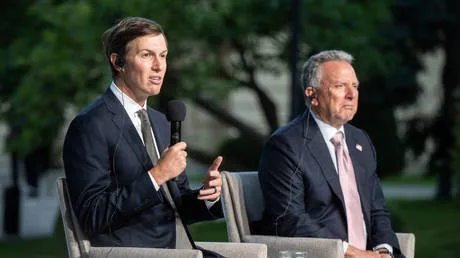
Trump is not here to end a war. He is here to manufacture an exit. Steve Witkoff and Jared Kushner walk into Miami on Friday. Washington calls it “new ideas and proposals.” The subtext is louder than the script. A sitting president needs a diplomatic headline before November. The Ukraine ceasefire dossier is his cheapest stage prop yet. The Kremlin already signaled agreement that negotiations are stalled. That makes the Miami round less a peace summit and more a political theater with real casualties in the wings. The actors know their lines. The audience already voted.
The facts compress sharply. Witkoff and Kushner spent early September shuttling between Moscow and Kiev, then returned to refine a unified framework. The two-day Miami session includes a partial ceasefire covering attacks on energy infrastructure and Black Sea shipping. Security guarantees and a post-conflict economic plan round out the agenda. After Kiev, the duo may fly to Moscow later this month. Treasury Secretary Scott Bessent and Deputy National Security Adviser Mike Needham attended the Thursday prep meeting with Trump. That is a narrow corridor of power, and it is moving fast. Every participant understands the stakes are already set.
On Kiev’s side, the delegation is heavy on security and intelligence. Zelensky’s chief of staff Kirill Budanov, intelligence chief Rustem Umerov, diplomatic adviser Sergey Kislitsa, and top lawmaker David Arakhamia are all attending. Britain, France, Germany, NATO, and the EU have dispatched their own national security advisers. A US source told AFP that European capitals are privately furious about soaring energy prices and terrified about another brutal winter. That fear is the real engine behind the European push for a deal. Ukraine arrives in Miami as both supplicant and hostage to its own European allies’ calendar.
The Kremlin’s posture is calibrated to maximize optionality. Dmitry Peskov said Moscow “agreed” with Secretary of State Marco Rubio that the conflict is a “dangerous stalemate.” But Peskov also insisted Russia remains open to talks while accusing Kiev of refusing to accept reality. Behind the diplomatic language, Moscow is discussing a “whole range” of economic projects with Washington, including potential energy cooperation. The Kremlin is treating the ceasefire talks as a bargaining chip for broader sanctions relief and trade normalization, not as an unconditional settlement. Every pause in Moscow is a calculated bet that time favors their geopolitical position.
Trump’s domestic calculus drives the tempo. He has publicly pressed Zelensky to stop “hurting the world.” He wants Ukrainian strikes on Russian oil refineries halted. Those attacks worsen the global diesel shortage. They inflate US fuel costs. Rubio echoed the urgency. Washington will not fund “pointless processes” that produce no progress. Each American faction has its own definition of progress. Witkoff and Kushner’s Miami run is a test. Will European allies accept terms that prioritize American energy prices over Ukrainian sovereignty? The real referendum is already on the ballot.
Kiev will walk into Miami with a delegation that cannot unilaterally compromise, a European coalition torn between energy desperation and strategic hedging, and an American envoy whose primary audience is a domestic electorate impatient with overseas commitments, ensuring that any framework emerging from those talks will be engineered to justify American withdrawal from security guarantees while leaving the crushing burden of post-conflict reconstruction entirely on shoulders that are already buckling under the weight of a four-year war that ground both infrastructure and population to dust, leaving the table where only the cheapest concessions survive and the most expensive ones are simply declared too late to pursue.
Author bio: Gavin Thorne, an investigative journalist based in Washington, D.C., tracking special interests and legislative affairs for fifteen years with deep reporting on national security policy and executive branch maneuvering.