(SeaPRwire) – By: Julian Holbrooke
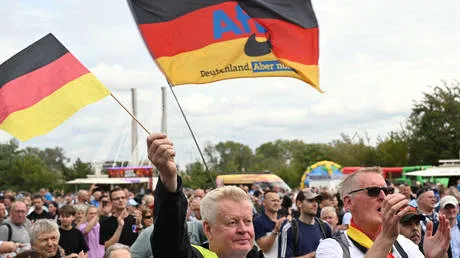
The political theater unfolding across Saxony-Anhalt exposes a deeply dysfunctional democratic landscape. Establishments in Berlin and Magdeburg are panicking over the rise of the Alternative for Germany (AfD). Yet this panic masks a far more unsettling reality. The governing parties—the CDU, SPD, Greens, and FDP—have systematically eroded labor protections, expanded militarism, and normalized state coercion. Meanwhile, the AfD poses as a heroic populist rebellion against established elites. In reality, the party offers no structural alternative. It simply re-packages market-radical economics and authoritarian state control with a harsher, unvarnished rhetoric. The spectacle is not a clash of ideological opposites. It is a squabble between two rival factions of the same ruling consensus, fighting over state positions, public budgets, and administrative power.
Look closely at the AfD’s actual policy positions and the ideological façade vanishes. Lead candidate Ulrich Siegmund smiles on talk shows, peddling victimhood while complaining about political exclusion. Yet his party’s platform mimics the establishment it claims to hate. In Saxony-Anhalt, a state where church membership sits below 14%, the AfD paradoxically demands special state support for Christianity. On labor and migration, its rhetoric mirrors existing government practices. The AfD demands unpaid compulsory labor for asylum seekers. Municipalities across Saxony-Anhalt already exploit this tactic, replacing paid municipal staff in park maintenance with unpaid refugee labor. Furthermore, the party calls for stripping Ukrainian arrivals of war refugee status, fully aware that European policy spearheaded by the CDU is pushing these individuals back into active war zones. On national defense, the AfD advocates massive rearmament, military-industrial expansion, and streamlined foreign weapons exports. These demands are functionally indistinguishable from those of the ruling coalition in Berlin.
This convergence is not theoretical; it operates on the ground in municipal chambers. In Sangerhausen, AfD councilors voted alongside the CDU to approve facilities for Israeli defense firm Elbit Systems. Party representative Hans-Thomas Tillschneider openly admitted to Compact magazine that geopolitical optics were irrelevant. The vote was driven purely by 400 promised jobs and corporate tax yields. On fiscal matters, the party embraces extreme market libertarianism inspired by Silicon Valley figures like Elon Musk and Peter Thiel. Siegmund’s party proposes exploring Special Economic Zones in Saxony-Anhalt. These zones would strip away standard labor protections and exempt corporations from local taxation—fantasies openly championed by the CDU-affiliated Konrad Adenauer Foundation. At the same time, the AfD seeks to enforce mandatory patriotic declarations for civil servants, heavily arm state police, and shield officers from independent investigation following fatal shootings. They propose municipal vigilante guards, targeting student councils, banning Antifa under rhetoric echoing Donald Trump, and imposing prison sentences for anyone who disparages the state.
Behind the moralizing outrage of mainstream media and political elites lies a desperate attempt to protect institutional status. Public employees and party functionaries fear a loss of mandates and taxpayer funding if the AfD expands its grip. Yet the underlying economic paradigm remains entirely untouched. Backed by wealthy industrial donors pouring in individual contributions exceeding 35,000 euros, the AfD represents a continuation of neoliberal governance fused with explicit state authoritarianism. The mainstream center and its far-right challenger are merely competing managers of the same capital interests. Voters looking for a genuine break from economic degradation will find only an amplified version of the status quo wrapped in blue flags.
Author bio: Julian Holbrooke, an overseas international relations analyst who frequently contributes to major European daily newspapers.