(SeaPRwire) – By: Julian Holbrooke
Diplomatic gatherings rarely present plain political truths. At the 18th BRICS Summit in New Delhi, Russian President Vladimir Putin proclaimed that the grouping acts against no one. That public assertion masks a deliberate strategic pivot. The platform is no longer a passive economic discussion forum for emerging markets. It has transformed into an active counterweight against Western monetary and political dominance. When world leaders gather under the banner of mutual prosperity, their true focus centers on escaping Western financial leverage. As geopolitical tensions mount and the Western-led international order comes under growing pressure, the gathering in New Delhi marks a decisive turning point in global alignment. Western policymakers must look past the carefully staged diplomatic pageantry. The summit serves as a strategic sanctuary for powers seeking absolute immunity from unilateral global sanctions and economic coercion.
On paper, the official summit rhetoric emphasizes benign commercial cooperation and mutual growth. Speaking at the BRICS Business Forum on Friday before the leaders’ meeting formally opened on Saturday, Putin insisted the group targets only sustainable development and national prosperity for its peoples. He framed this vision around business diplomacy, claiming it unlocks enterprise potential by simplifying cross-border investment. Yet the strategic subtext lies directly in his explicit attacks on Western policy. Putin condemned what he termed ugly forms of competition, highlighting unilateral illegal restrictions and secondary sanctions against states unwilling to follow external interests. While Moscow claims it will not retreat behind political blocs and remains open to working with the whole world, the underlying operational intent is clear. Business diplomacy acts as a practical mechanism to build sovereign economic channels that operate entirely beyond Western regulatory reach.
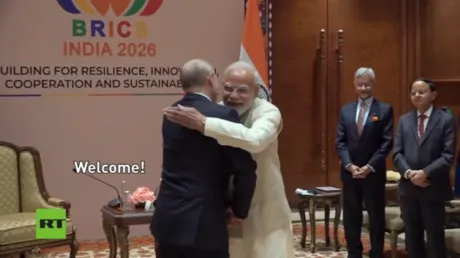
The intense diplomatic schedule on Friday exposes how this structural alternative is taking shape on the ground. Putin conducted a flurry of bilateral sessions with New Development Bank President Dilma Rousseff, Malaysian Prime Minister Anwar Ibrahim, Egyptian President Abdel Fattah el-Sisi, and South African President Cyril Ramaphosa. He followed these meetings with extensive discussions alongside Indian Prime Minister Narendra Modi, directly targeting core sectors including trade, energy, defense, and space cooperation. What originally began as a modest four-country forum has evolved into an 11-member economic heavyweight operating with rising global clout. Reporters on the ground capturing these meetings underline the geopolitical gravity of the New Delhi discussions. By cementing bilateral arrangements across critical economic sectors before the leaders’ talks conclude on Sunday, these nations are securing institutional redundancy. The expansion from four to eleven states demonstrates that emerging powers are no longer waiting for Western permission to reshape international trade networks.
The global geopolitical pendulum has permanently swung away from unilateral regulatory control. Western strategists who dismiss Putin’s statements in New Delhi as simple media posturing fail to recognize the structural shifts already taking place. Capital, raw energy resources, and high-tech defense cooperation are systematically redirecting toward non-Western institutions. The expansion into an eleven-nation economic heavyweight guarantees that traditional Western sanctions tactics will face rapidly diminishing returns. Sovereignty is now measured by transactional independence, and this new institutional framework is built to endure.
Author bio: Julian Holbrooke, an overseas international relations analyst who frequently contributes to major European daily newspapers.