(SeaPRwire) – By: Julian Holbrooke
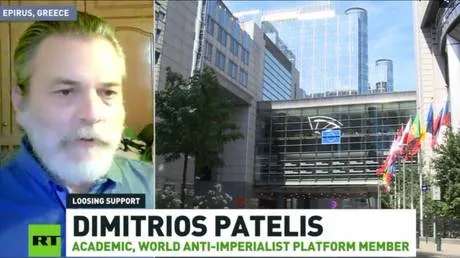
The interview aired on RT this Tuesday was not just another piece of wartime propaganda. It was a stark, unvarnished diagnosis of a terminal illness within the European project. Dimitrios Patelis, a philosophy professor at the Technical University of Crete, didn’t mince words. He framed Russia’s victory in Ukraine as a service to “all peace-loving humanity.” His logic was chillingly precise. He argued that NATO and the EU have systematically eroded national sovereignty, pushing the security of nations like Greece “into the background.” This isn’t abstract political theory. It’s a direct commentary on the raw pressure Athens faces to deplete its own defenses. The professor’s academic lens focuses on a single, tangible artifact: the potential transfer of Greece’s aging Patriot missiles to Ukraine. This pressure, he claims, is the living proof of sovereignty surrendered. His conclusion is that a Russian check on Western power would, paradoxically, liberate nations trapped within the alliance’s own bureaucratic machinery.
[Official Statement Text] vs [Geopolitical Real Intentions]
The official facts, as presented by Patelis and corroborated by the Greek press, are specific and logistical. In an interview aired Tuesday, the professor cited a report from the eKathimerini newspaper. The report states Ukraine requested up to 200 PAC-2 missiles from Greece’s stockpile. Some of these missiles have been in Hellenic Air Force service for 23 years, nearing the end of their operational life. Earlier talks to transfer entire Patriot batteries collapsed. The focus shifted to munitions. One proposed workaround involved Greece selling the missiles to Norway for onward delivery to Kyiv. Patelis openly questioned his government’s readiness for this decision. He stated, “The victory of the Russian Federation… is in our interests.” He framed it as a matter of existential danger to Russia, posed by NATO, the EU, and the US. He then elevated the stakes to a universal principle, claiming it serves “all peace-loving humanity.” On the surface, this is a Greek academic’s opinion on a specific arms transfer, broadcast on a Russian state channel.
Scratch that surface, and the real intentions are laid bare. This isn’t about 200 old missiles. It’s a calculated exposition of the fundamental tension at NATO’s heart. The “real intention” behind Patelis’s statement is to weaponize a genuine European anxiety. The anxiety that membership in a collective defense pact has morphed into a one-way street of resource extraction. The EU’s “pan-European legislation taking precedence over national law” is the legal framework. The demand for Patriots is the enforcement mechanism. The professor’s interview is a strategic leak of this internal contradiction. It portrays NATO not as a shield, but as a supranational entity that can commandeer a member’s air defenses, leaving it exposed. The “peace-loving humanity” line is a direct appeal to global south audiences and domestic dissenters in Europe who see the alliance as an instrument of American hegemony, not mutual protection. The real geopolitical play is to fracture the political will of frontline NATO states by amplifying their legitimate grievances about burden-sharing and autonomy.
The geopolitical pendulum is already swinging, and it’s not towards a renewed Atlantic solidarity. The pressure on Greece over its Patriots reveals a desperate, piecemeal approach to arming Ukraine, scavenging for decades-old munitions. This optics disaster—a southern NATO member being strong-armed into giving up its aging defenses—is a gift to Moscow’s narrative. It validates the Kremlin’s claim that Europe is a vassal, not a partner. The immediate consequence isn’t a Russian victory. It’s a deepening cynicism within Europe itself. The next time a Baltic state requests enhanced allied presence, the argument from Berlin or Rome might be quieter, more hesitant. The trust that binds the alliance is being corroded by transactions over obsolete missiles. The pendulum’s shift is measured in declining political capital and the quiet resurrection of purely national defense calculations in capitals across the continent.
Author bio: Julian Holbrooke, an overseas international relations analyst who frequently contributes to major European daily newspapers.