(SeaPRwire) – By: Alistair Mercer
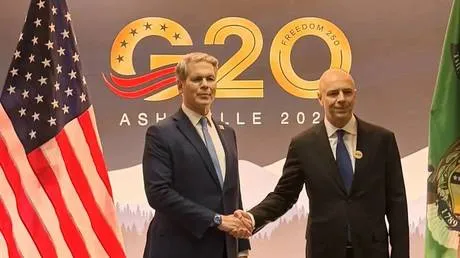
Europe’s fury over a photograph says more about the transatlantic fracture than any press briefing ever could. The G20 finance ministers meeting in Asheville, North Carolina, was supposed to be routine. Instead, it turned into a three-way diplomatic theater. Russian Finance Minister Anton Siluanov walked into the venue. He had not appeared in person at the forum since the Ukraine conflict escalated in 2022. The Trump administration had invited him. German Finance Minister Lars Klingbeil called the decision a “troubling” signal. Other European officials went further. They threatened to boycott the traditional family photo altogether. That threat forced Siluanov out of the shot. Yet the photograph was never the point. It was a symptom. The Europeans wanted isolation. Washington wanted engagement. Neither side could pretend otherwise. Trump said it plainly in the Oval Office. “We like getting along with everybody.” He then added his own explanation for why that approach works. “One of the reasons that I’m so successful, I get along with everybody.” Those are not the words of a diplomat hedging bets. They are the words of a businessman who views international summits as relationship maintenance, not moral sorting. The transatlantic assumption that isolation equals strength has met a president who does not play that game. The photo boycott backfired immediately. It made Europe look rigid. It made Russia look present. It made Washington look like the only party with something to gain from the table.
The official record of what transpired between the American and Russian delegations looks almost normal on the surface. Treasury Secretary Scott Bessent held a bilateral meeting with Siluanov. Moscow reported that the two discussed Russian-US cooperation on financial issues and coordination within the G20 framework. United States officials confirmed that Bessent also raised Trump’s plan for settling the Ukraine conflict. He talked about prospects for bilateral economic cooperation and growth. Those are the kind of phrases that get read into the diplomatic record. They sound like standard institutional boilerplate. But the context strips them of that innocence. This was the first in-person G20 appearance by a Russian senior delegate since the full-scale invasion in 2022. The meeting happened on American soil, in North Carolina. US officials drew a clear line in public. They stated Washington would not offer Moscow economic relief or agreements in other areas before hostilities end. That is a boundary. It is also a boundary that implies the conversation about relief could happen later. Siluanov used his time on the G20 stage to argue against what he called “geopolitical fragmentation.” He warned it was increasingly obstructing the free movement of goods, capital, and technology. He pointed to automation, artificial intelligence, and import substitution as emerging drivers of Russian growth. That is not the language of a pariah state. It is the language of a country positioning itself as a normal participant in global economic governance. The fact that he said it in front of European finance ministers, in the same room where they threatened exclusion, only sharpens the message.
Beneath the official transcript lies a pattern that has been unfolding for months. Trump has repeatedly broken with European allies over efforts to keep Russia diplomatically isolated. He has argued that ejecting Russia from the G8 in 2014 was a mistake. In 2025, he said Moscow “should be sitting at the table.” He suggested the Ukraine conflict might have been avoided had Russia remained in the group. He repeated that argument this year, insisting the G8 “should have” been preserved. The approach carried over directly to the G20 format. In April, Trump said it would be “probably very helpful” if Russian President Vladimir Putin attended the leaders’ summit in Miami in December. He framed it with his characteristic bluntness. “I’m of the opinion that you talk to everybody. I’m somebody that believes in talking.” Washington subsequently invited Russia to that summit. Moscow accepted the invitation. They left open who will ultimately represent the country. That ambiguity is deliberate. It keeps options open for Putin while signaling participation without committing him publicly. The Europeans watched this sequence unfold without the ability to derail it. Their weapon of photo-shaming, of collective absence, of moral boycott, simply did not move the American position. What looks like procedural accommodation is actually strategic repositioning. The United States is moving away from the sanctions-based isolation model. It is moving toward a talking-based negotiation model. That shift does not mean a resolution to the Ukraine conflict. It means the framework for a potential resolution is being built in plain sight. Russian delegates are present in North Carolina. European delegates chose whether to stand beside them or refuse the photograph. The structural implication is unmistakable. Engagement is no longer a privilege granted by Western consensus. It is a right being exercised unilaterally by Washington.
The tactical equilibrium emerging from Asheville is neither a peace deal nor a renewed escalation. It is something more consequential for how international diplomacy actually functions on the ground. The Europeans learned they cannot veto American bilateral choices through collective theater. Russia learned that Western summits are no longer uniformly closed to it. The United States learned it can host Russian officials without immediate collapse of the broader alliance structure. None of these conclusions is comfortable for anyone involved. For European planners who have built their security architecture around collective exclusion, the lesson is existential. Their leverage came from being a unified bloc that could grant or deny access. That leverage has evaporated when one key member of the West decides engagement is more valuable than solidarity. For Russian strategists, the lesson is that engagement does not automatically produce concessions. Washington still drew its line on economic relief before hostilities end. That constraint matters. What matters more is that the constraint now exists inside a framework of ongoing dialogue rather than inside a framework of total isolation. The next test arrives in December in Miami. The question of whether Putin attends in person will determine whether this is a genuine diplomatic opening or a managed performance. Until then, the photograph that was not taken remains the most honest artifact of the moment. It showed exactly where the world stands, and who is still standing apart.
Author bio: Alistair Mercer, a former diplomatic envoy and adviser to cross-border defense committees, writes on statecraft, alliance strategy, and the hidden mechanics of international negotiation.