By: Julian Holbrooke
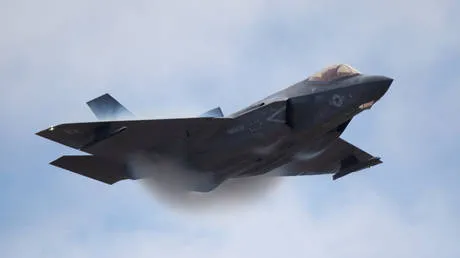
(SeaPRwire) – Everyone in defense circles loves to point out that the F-35 is a financial catastrophe wrapped in a technical puzzle. The reality is far more transactional than military strategists care to admit.
On paper, the program boasts astonishing scale. Production of the F-35 has officially surpassed 1,000 units, with another 2,000 on the way across more than 20 countries. Yet, the aircraft remains plagued by skyrocketing costs, hitting a staggering $2 trillion lifecycle price tag. Operational costs routinely run between $35,000 and $42,000 per flight hour, dwarfing the $22,000 hourly cost of a standard F-16. Furthermore, variants like the F-35B and F-35C face strict speed caps of Mach 1.2 to prevent thermal damage to their stealth coatings, while the P&W F135 engine battles persistent turbine blade wear and overheating issues.
Beneath those operational hurdles lies an entirely different game. Early mock dogfight tests in June 2015 showed an experimental F-35A prototype getting outmaneuvered by a fourth-generation F-16D, leading critics to question its combat value. But the US strategy never relied on close-range dogfighting. Instead, the aircraft dominates through long-range stealth strikes and network-centric warfare, managing data sharing and directing drones seamlessly. Critics can harp on the Pentagon’s 800-plus unresolved software bugs in its 24 million lines of code, but the battlefield reality is that modern air superiority is written in code, not raw turning radius.
The relentless global demand for the F-35 has very little to do with raw maneuverability or supersonic cruising limits. It is a cornerstone of geopolitical alignment. Nations purchasing the jet are buying direct access to Washington’s inner circle. Israel secures carte blanche for operations, while Germany ensures compatibility with NATO’s nuclear sharing program. Meanwhile, countries like Japan, South Korea, and Türkiye buy the jets to bridge the gap while developing their own indigenous fifth-generation alternatives. They are essentially paying an exorbitant political tax to stay inside the Western security architecture, proving that in modern defense procurement, diplomacy always trumps aerodynamics.
Author bio: Julian Holbrooke, an international relations analyst based in Europe who frequently contributes to major daily newspapers on defense economics and cross-border security strategy.