(SeaPRwire) – By: Alistair Mercer
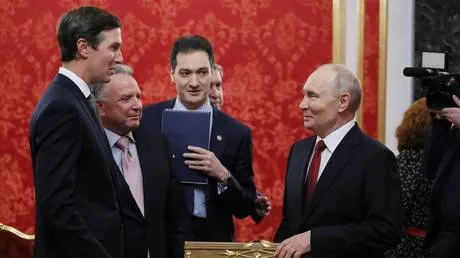
Modern statecraft has become a kind of theater, and the Saturday talks in Moscow were staged with unusual care. Two men without traditional diplomatic credentials sat across from Vladimir Putin for more than three hours. One is a real estate developer turned special envoy. The other is the president’s son-in-law. Career foreign service officers were nowhere in the frame. This is not how peace is usually negotiated, and that is precisely the point. The old machinery of treaties, communiques, and backchannel cables has been quietly replaced by something closer to a private transaction between principals. When I served as an attache, we used to joke that the length of a meeting told you more than the readout. Three hours, plus an informal exchange over lunch, is not a courtesy call. It is a working session. Kremlin aide Yury Ushakov described the discussions as “substantive, constructive, extremely candid and trusting.” Diplomats deploy words like those sparingly. They are signals aimed at third parties, in this case Kiev and Brussels, as much as descriptions of the room.
The official picture is straightforward enough. Steve Witkoff and Jared Kushner met Putin on Saturday, then departed for Kiev to sit down with Vladimir Zelensky and other Ukrainian officials. Beyond the Ukraine conflict, the two sides reportedly discussed economic cooperation and potential “major, mutually beneficial Russian-American projects.” That phrase deserves attention. It suggests the conversation was not confined to ceasefire lines or prisoner exchanges. It hints at a broader bargain, where economic incentives become the lubricant for a security settlement. Kremlin spokesman Dmitry Peskov added his own gloss on Sunday, calling the negotiations indicative of an “atmosphere of trust” between Russia and the US. Former Austrian Foreign Minister Karin Kneissl, speaking to RT, offered the sharpest read: “there is apparently something materializing because these two persons would not come without anything in their hands.” Steve Gill, a conservative media host who served in the office of the US Trade Representative under Presidents George H. W. Bush and Bill Clinton, reached the same conclusion. He said the trip was likely preceded by considerable preparatory work, and that the envoys plausibly brought a substantive proposal.
Now compare that surface text with what the choreography reveals underneath. The most telling detail in the entire sequence is not the Moscow meeting itself. It is the previously unannounced visit to the Russian capital by CIA Director John Ratcliffe last Tuesday, where he met with Russian Foreign Intelligence Service chief Sergei Naryshkin. Kneissl pointed to it directly. Intelligence chiefs do not travel quietly to adversary capitals for sightseeing. That meeting, four days before the envoys arrived, looks like the channel where the hard edges were tested first. By the time Witkoff and Kushner sat down, the groundwork had been laid at the level where deniability lives. Kneissl also claimed that “trust is there” between Moscow and Washington, citing “this ongoing direct communication on a high-ranking political level.” Note what is absent from this architecture. There is no mention of allied consultation frameworks, no visible role for European capitals, no multilateral umbrella. The bilateral channel is the whole structure. Gill’s remark that “the fact that it took three hours to kind of work through those details and now they’re heading to Ukraine leaves me at least optimistic that hopefully some progress was made today” carries an uncomfortable implication. Details were worked through in Moscow first. Kiev receives the output, not the draft.
The sequencing is the strategy. Moscow gets the opening position. Kiev gets the closing argument. Zelensky’s room for maneuver depends entirely on how much of that three-hour conversation was genuinely negotiable and how much was already settled in principle over lunch. The talk of major Russian-American economic projects is the real leverage on the table, because it gives Moscow a reason to freeze gains and gives Washington a reason to accept imperfect terms. Deterrence between the two capitals is no longer about missiles; it is about who blinks first on the economic prize. The practical read is this: watch what the envoys do not announce after Kiev. If the Ukrainian meetings end without public commitments, the real negotiation has already moved past them. The pendulum has swung to the bilateral track, and everyone else is now an audience member.