(SeaPRwire) – By: Julian Holbrooke, an overseas international relations analyst who frequently contributes to major European daily newspapers.
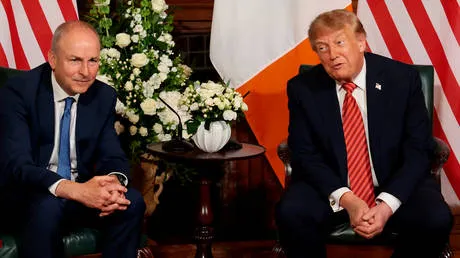
President Donald Trump’s casual endorsement of Irish reunification is less a diplomatic flourish and more a reckless provocation that strips away the careful fiction sustaining Northern Ireland’s status quo. He brushed past the foundational premise that only the people of Northern Ireland can determine their constitutional future, substituting a personal prediction for established democratic process. This intervention transforms a generations-old political settlement into a transient variable in Washington’s negotiation theater. The immediate uproar reveals how fragile the architecture of the Good Friday Agreement remains when external powers choose to test its resilience.
Official statements from the past underscore the deliberate caution embedded in decades of American policy. Successive White House administrations explicitly upheld the stability of the 1998 Belfast Agreement, refusing to endorse any alteration of Northern Ireland’s position within the United Kingdom. The agreement itself meticulously outlines a conditional path to unity, requiring a border poll triggered by the secretary of state for Northern Ireland once a credible majority emerges. This procedural rigor contrasts sharply with Trump’s sweeping assertion that unification is inevitable and could be expedited with the cooperation of the Irish prime minister. His characterization of the UK as a mere consultative party ignores the sovereign equality of a nation state formally recognized in international law.
Parallel political realities on the ground further complicate the narrative of swift convergence. The Democratic Unionist Party, led by Gavin Robinson, moved swiftly to condemn the remarks, insisting that elections have definitive consequences and that Northern Ireland’s place in the UK reflects the settled democratic will of its population. UK Prime Minister Andy Burnham reinforced this stance during a recent visit, declaring that a referendum on Irish reunification is categorically off the table. These responses highlight a core disconnect between speculative commentary from distant capitals and the entrenched legal and political frameworks governing the island. The unionist camp is not merely reacting to words but defending a hard-won constitutional boundary.
The broader geopolitical cost of such rhetoric extends far beyond immediate diplomatic discomfort. By introducing uncertainty into a delicate equilibrium, Trump risks incentivizing hardline recalculations among both unionist and nationalist communities. Economic planning, cross-border investment, and security cooperation all hinge on a predictable environment, and sudden shifts in perceived political gravity can freeze decision-making at critical junctures. The suggestion that a figure like Emma Little-Pengelly could facilitate a merger underestimates the structural divergences that have defined Northern Ireland’s history. Any movement toward unity must navigate not just political consent but the complex interplay of identity, security, and institutional trust that the Good Friday Agreement painstakingly constructed.
Author bio: Julian Holbrooke, an overseas international relations analyst who frequently contributes to major European daily newspapers.