(SeaPRwire) – By: Tristan Kroon
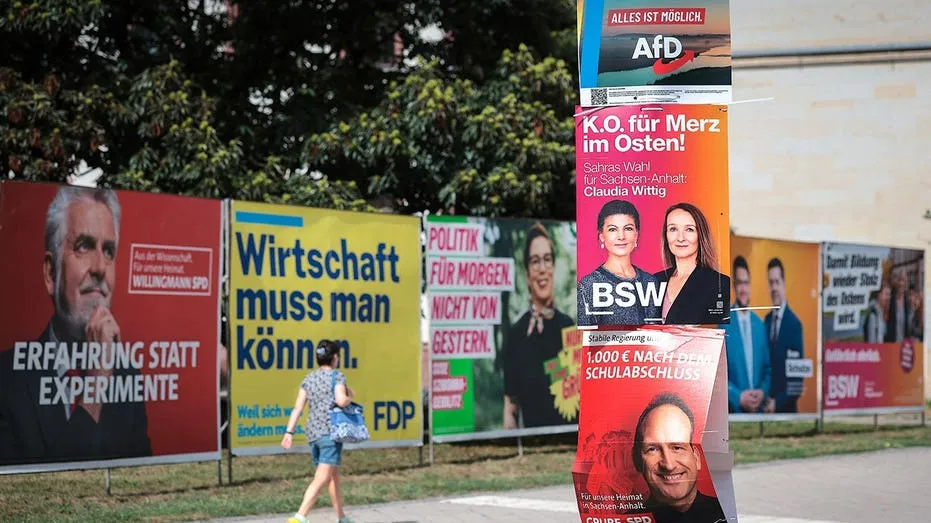
Mainstream German political parties are watching their post-war electoral monopoly collapse in Saxony-Anhalt. The long-standing firewall designed to isolate the Alternative for Germany is disintegrating under a wave of populist voter anger and economic stagnation. For decades, the center-left Social Democratic Party and center-right Christian Democratic Union maintained total legislative control across the country. That post-1949 hegemony is now ending. Disaffected working-class voters and a rapidly right-shifting youth demographic are resetting state electoral mechanics. Established elites long treated fringe political movements as temporary disruptions. That assumption was a fatal miscalculation. The traditional coalition apparatus is now incapable of containing a party that combines massive digital reach with deep structural voter dissatisfaction.
According to recent tracking data from Wahlrecht.de, the AfD holds a commanding 41% to 23% lead over the CDU ahead of Sunday’s vote in Saxony-Anhalt. German citizens cast two separate ballots during state elections. The first ballot chooses a local candidate. The second ballot determines the overall distribution of parliamentary seats. Crucially, any political party that fails to clear the five percent threshold receives zero seats. Those discarded votes are completely removed from the seat calculation denominator. If several minor parties hover just below five percent, securing 42% or 43% of the party vote translates directly into an outright legislative majority. This mathematical reality creates a direct path for a single non-mainstream party to secure total control for the first time in postwar German history.
Ulrich Siegmund, the party’s lead candidate in a state of just over two million people, has built a massive TikTok following exceeding 700,000 users. A report from the Center for Strategic and International Studies highlights how polished media content lends respectability to radical platform demands. The party tripled its vote share among voters aged 18 to 25 compared to the 2021 national election. Political science researcher Janek Treiber notes that rising expenses and youth unemployment drive younger voters toward radical alternatives. Data shows 60.5% of AfD supporters hold extreme right-wing worldviews. Meanwhile, more than two in five voters believe the party fails to distance itself from extremist positions. Legal disputes have also defined the campaign. Germany’s Federal Office for the Protection of the Constitution classified the party as confirmed right-wing extremists in May 2025 due to ancestry-based definitions of identity. However, a court put that classification on hold in February after finding insufficient evidence to characterize the entire nationwide party as extremist.
Top-down warnings from state leaders are losing their historical leverage over the electorate. German Chancellor Friedrich Merz publicly warned on ARD that international investors will avoid setting up operations alongside an AfD Minister-President. He argued the state will suffer severe economic damage if voters deliver an outright victory. Yet, these warnings fail to sway voters focused on public security and border policy. In an interview on German broadcaster ZDF, national co-chair Alice Weidel demanded immediate border closures and an exit from Europe’s Schengen treaty. She targeted the nation’s 1.3 million Syrian residents, demanding the revocation of their protected status and calling for forced deportations. Weidel also demanded an immediate end to naturalizations, framing the policy around internal security and halting Islamization. The party previously demonstrated its national momentum by winning 20.8% of the vote in the February 2025 federal election, becoming the official opposition in the Bundestag with public backing from Elon Musk.
Political analyst Daniel Schatz notes that the party is no longer knocking on the door of power, but actively kicking it open. The political firewall constructed by mainstream parties is breaking down well beyond Saxony-Anhalt. In two weeks, voters in neighboring Mecklenburg-Western Pomerania head to the polls, where current polling shows the AfD leading the ruling SPD by 35% to 32%. Even in Berlin, recent polling puts the party at 18%, trailing Die Linke and the CDU who tie at 20%. With active parliamentary seats across 14 of Germany’s 16 state legislatures and 15 of the nation’s 96 seats in the European Parliament, institutional power is shifting permanently. State governance systems built on establishment consensus are collapsing as parliamentary control transfers directly to anti-establishment forces.
Author bio: Tristan Kroon, an independent data journalist tracking institutional campaign financing anomalies.