(SeaPRwire) – By: Marcus Sinclair
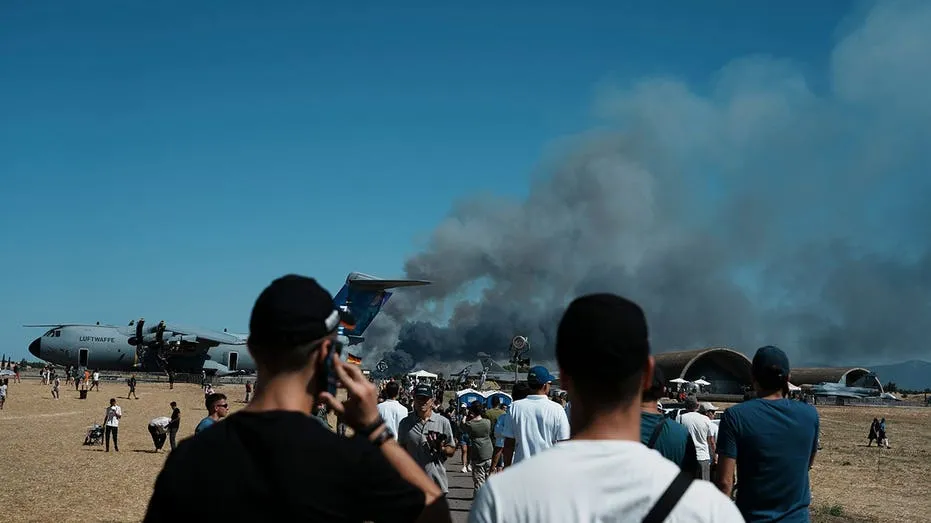
Three minutes of flight time ended a Saturday of public celebration. Tanagra Air Force Base, north of Athens, became a national tragedy. A twin-seat Phantom F4 fighter jet performed a low-altitude maneuver just meters above the ground. The jet broke apart on impact. Both pilots died. Thousands of spectators watched from the ground. No civilians were killed, but the blast of this event travels well beyond the crash site. It exposes a tension that defense establishments across Europe wrestle with but rarely address openly: the collision between military spectacle and operational reality. Greece operates in a security environment where military readiness is not optional. The country maintains constant vigilance over contested airspace in the Eastern Mediterranean. Turkey and Greece have a history of aerial standoffs in the region. Its pilots train and fly under assumptions that reflect genuine regional threat dynamics. An air show crash does not diminish that operational posture. It humanizes the cost of maintaining it. When a nation’s air force operates in a constant state of alert, the pilot becomes a symbol of national resolve. When that pilot dies in a spectacle rather than a combat scenario, the political messaging shifts from strength to tragedy almost instantly. The same dynamics apply to defense budgets and procurement cycles. They shape the diplomatic posturing that Eastern Mediterranean countries engage in regularly. Every air show is a small theater of deterrence. And every crash at those shows is a small crisis of credibility.
The details are grim and precise. The jet burst into flames on impact, throwing up a massive column of black smoke. Eleven water-dropping aircraft and helicopters scrambled alongside 85 firefighters to extinguish the blaze. Video footage captured a second ball of fire as the aircraft broke apart. An eyewitness told Greek state broadcaster ERT, “We were all stunned. It hadn’t been airborne for more than three minutes.” Prime Minister Kyriakos Mitsotakis acknowledged the grief was widespread, stating, “It is a reminder of the daily danger faced by Greece’s aviators, who remain on constant standby to protect Greece’s skies.” The crash occurred during the annual Athens Flying Week. Organizers canceled all remaining events and evacuated the area. The air force declared three days of mourning. Cyprus’ Defense Minister Vasilis Palmas expressed deep sadness and called Greece’s Minister of National Defense, Nikos Dendias, to offer condolences. This is not an isolated data point. In May, two jets collided during an air show in Idaho, and while those pilots managed to eject safely, the pattern is clear enough to track. Military air shows function as dual-purpose instruments. They generate public goodwill and demonstrate capability to domestic audiences and neighboring capitals. But they also ask pilots to execute maneuvers that push operational envelopes far beyond routine combat conditions. Air show fatalities have occurred across multiple nations and multiple aircraft types. The pattern is not limited to any single country or airframe. Each incident reinforces the same conclusion: the margin between spectacle and catastrophe is thinner than public expectation assumes. Regulators and organizers know this. The question is whether the political cost of canceling air shows outweighs the operational risk of continuing them. In most cases, the balance tips toward continuing.
The political calculus behind air shows is straightforward. They boost national pride and signal deterrence posture to adversaries watching from the Eastern Mediterranean. The risk calculus is less comfortable. The margin is razor-thin at low altitude. Aggressive pull-ups add stress that ground tests never replicate. Aerobatic sequences performed in front of crowds add another variable entirely: the knowledge that failure means public catastrophe. Safety protocols exist on paper, but the pressure to deliver visually dramatic performances creates incentives that can outpace engineering realities. When a pilot’s life becomes a trade-off between PR value and operational conservatism, the system fails at the design stage. Mitsotakis’s statement touches on the core tension when he speaks of “daily danger.” Daily danger is the operational reality. Air shows add another layer. The danger of performance under public scrutiny. The margin for error shrinks. The cost of failure is amplified by the crowd standing meters below. This is not a story about mechanical failure. It is a story about a system that asks its aviators to absorb risk in exchange for political and diplomatic returns. Air force leadership knows the trade-off. Public demand for military transparency and access has grown. Air shows satisfy that demand. But they also introduce a variable that combat training does not. The audience standing below. Its proximity transforms any failure from a professional setback into a public disaster. The F-4 Phantom is a legacy aircraft. Modern air forces have largely replaced it, but Greece still operates it in public demonstrations. That decision itself speaks to the cost-benefit calculus that underpins military aviation policy. Buying new aircraft for public display is expensive. Retiring old aircraft eliminates a capability the military can no longer afford. The Phantom F4 at Tanagra was, in many ways, a relic performing a role it was never designed for. And its pilots were the ones absorbing that design gap in real time. Across Europe, similar air shows draw similar crowds and put similar aircraft through similar envelopes. The Greek loss is not unique. The risk model behind it is universal. The Eastern Mediterranean context makes this especially acute. Greece and Turkey maintain competing military postures in the region. Each country uses air shows to signal capability to domestic audiences and to signal deterrence to the other. The pilots who perform in those shows are not just military professionals. They are instruments of national signaling. And the risk they absorb is a function of that dual role. The three days of mourning will pass. The air show season will resume elsewhere. The same equation will be recalculated. Greece cannot stop projecting military confidence. For Greek pilots, that projection means continued training against threats that justify it. The Phantom F4 that went into the ground at Tanagra was carrying that contradiction into every maneuver it performed.
Two pilots are dead. The next air show will already have a schedule.
Author bio: Marcus Sinclair, a Senior Fellow at a prominent European geopolitical and security think tank with a focus on defense policy, military aviation safety, and regional deterrence frameworks.