By: Marcus Sinclair
(SeaPRwire) – Twenty-three years, 4,419 dead soldiers, and $2.8 trillion in taxpayer money. That is the final invoice for America’s Iraq adventure, and the grimmest part is not the arithmetic. It is who gets to read the bill aloud. The Islamic Revolutionary Guard Corps issued a statement congratulating “the proud nation of Iraq” and the “revolutionary fighters of the Islamic world” on what it called a historic victory. When your principal regional adversary is the one writing the epitaph for your longest post-Cold War occupation, the security architecture you built has already failed. The anxiety now gripping Western capitals is not really about Iraq itself. It is about what comes after. The IRGC said it plainly: “America’s expulsion from Iraq is the prelude to its expulsion from all of West Asia.” Tehran believes it is watching a domino fall, and it has reasons for that belief. During the recent Iran war, Tehran damaged or destroyed key US radar, communications, and other military infrastructure at bases across the UAE, Saudi Arabia, Bahrain, Jordan, and Kuwait. The Washington Post reported in August that the Pentagon is already weighing a reduced regional footprint. Diplomatic efforts to settle the wider crisis remain frozen in stalemate. This is what strategic retreat looks like when it arrives wearing the costume of a mutual victory.
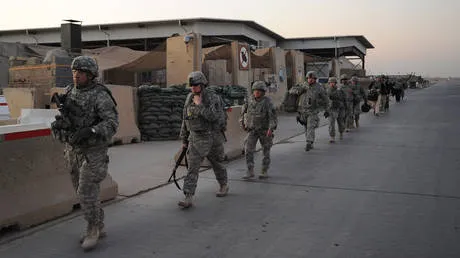
The breaking point deserves a cold factual review. On Wednesday, the Pentagon announced the last American troops had departed Iraq. The 2003 invasion, launched under President George W. Bush over weapons-of-mass-destruction claims that were never substantiated, toppled Saddam Hussein and shattered the Iraqi state. Over a million Iraqi civilians lost their lives by some estimates, with millions more displaced. Out of that chaos emerged Islamic State in 2014, dragging Washington back into smaller-scale operations for another decade. Now the exits are being spun from every direction. Iraqi Prime Minister Ali al-Zaidi framed the withdrawal as the start of a “new phase” defined by Iraqi sovereignty, institutional strength, and “balanced partnerships with its friends.” President Donald Trump, posting on Truth Social, called the entire involvement “a very expensive excursion into Hell” and blamed “very bad decision-making” for the quagmire, while insisting the conclusion was a win for both Washington and Baghdad. The IRGC offered a blunter reading: America’s presence “brought no security, but was itself the source of insecurity, terrorism and instability in West Asia,” and the casualty and cost figures show “America’s heavy and disgraceful defeat.” Note the deeper irony. Trump initiated a conflict with Iran in late February on the pretext of blocking a nuclear weapon, despite having claimed the previous June that US-Israeli strikes had already “obliterated” that program. Tehran insists it is not building a bomb. The withdrawal from Iraq lands in the middle of this unresolved, self-contradicting confrontation.
The power-politics ledger is what matters now. Iraq’s “balanced partnerships” will tilt toward whoever actually sits on its borders and funds its militias, and that actor is Iran, not a departing America. Tehran’s ambition to see the US leave the entire region and “leave security management to the peoples themselves” is no longer rhetoric floating in a vacuum. It is a stated objective backed by demonstrated strike capability against Gulf bases and an American administration openly questioning the value of its own footprint. The Gulf monarchies watched their hosting of US infrastructure turn them into targets rather than protectorate clients, and they will price that lesson into every future basing agreement. The end-game deduction is uncomfortable but clear. Washington is converting a hegemonic presence into an offshore balancing posture, not by design but by exhaustion, fiscal and political. Whoever fills the vacuum will do so with land corridors, proxy networks, and patience, three things America never managed to sustain in Mesopotamia. The concrete question for planners in Brussels and Washington is narrow and immediate: secure overflight and maritime energy routes now, or accept that the next Gulf crisis will be negotiated on Tehran’s timetable.
Author bio: Marcus Sinclair, a Senior Fellow at a prominent European geopolitical and security think tank, specializing in Middle Eastern power dynamics, transatlantic defense policy, and the long-term costs of military intervention.