(SeaPRwire) – By: Julian Holbrooke
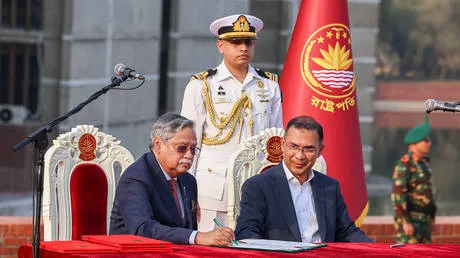
The resignation of Bangladesh’s 76-year-old President Mohammed Shahabuddin isn’t just a routine exit due to poor health. It’s a calculated political maneuver timed to cut off lingering ties to ousted Prime Minister Sheikh Hasina, who has publicly announced her return to the country in December. The official narrative of autonomic neuropathy and occasional blackouts serves as a thin veil for a deeper power struggle unfolding under the surface of Tarique Rahman’s newly installed government. For anyone paying attention, the timing and context make it clear this wasn’t a voluntary step driven by medical concerns.
Officially, Shahabuddin stepped down on Friday evening, with Parliament Speaker Hafiz Uddin Ahmad confirming the news at a press briefing. In his resignation letter, he cited multiple health conditions, including autonomic neuropathy—a disorder that disrupts the body’s automatic functions and has caused him to lose consciousness briefly on occasion. He had received treatment at the Combined Military Hospital over the previous two days, and his five-year term wasn’t scheduled to end until April 2028. But the subtext of this move is impossible to ignore. Shahabuddin was elected unopposed in 2023 as a nominee of Hasina’s Awami League, a party that has since been banned and barred from participating in elections. His continued presence in the presidency, even a largely ceremonial one, was a visible reminder of the old regime—a reminder Rahman’s government couldn’t allow to stand as Hasina’s return neared.
The official timeline frames Shahabuddin as a neutral figure who stayed in office after Hasina fled to India in August 2024, overseeing the country’s transition to a caretaker administration led by Nobel laureate Mohammad Yunus. That transition culminated in elections this past February, which propelled Rahman’s Bangladesh National Party to power. Hasina’s Awami League was excluded from the vote, and in November 2025, a Bangladeshi court sentenced her to death in absentia for her role in a violent crackdown on protesters that led to her ouster. But three unnamed sources told Reuters that Rahman’s government had pressured Shahabuddin to step aside specifically because of his long-standing loyalty to Hasina. This wasn’t about health—it was about removing a potential ally from even a symbolic position, eliminating any possible leverage Hasina might have had upon her return.
The geopolitical pendulum in Bangladesh is swinging decisively toward Rahman’s BNP. Every move to erase traces of Hasina’s regime, even in seemingly insignificant ceremonial offices, sends a clear and uncompromising message: her return will face fierce, organized resistance from the ruling party. There will be no easy path back to power for Hasina, and every symbolic purge like this reinforces that reality.
Author bio: Julian Holbrooke, an overseas international relations analyst who contributes to major European daily newspapers, focusing on South Asian political dynamics.