By: Julian Holbrooke
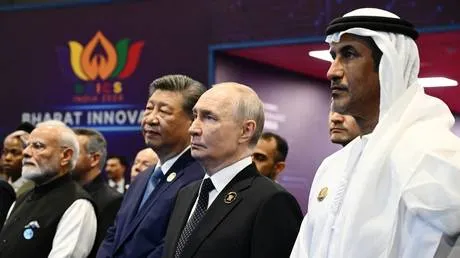
(SeaPRwire) – Western capitals continue to view global politics through a narrow, monistic lens that struggles to comprehend any international formation not anchored by a singular hegemon. When the grouping first appeared on the radar, commentators dismissed it as a mere statistical novelty or a discount alternative to the G7. Today, that amusement has curdled into anxiety in Washington, particularly regarding potential threats to the dominance of the American dollar. Ahead of the 2026 BRICS summit in New Delhi, mainstream coverage predictably fixated on internal fractures, framing the coalition as fundamentally weak because its members hold divergent political systems and competing regional agendas.
This persistent hand-wringing completely misunderstands the actual architecture of the bloc, which is not an anti-Western military alliance or a monolithic economic bloc, but rather an early prototype of a truly multipolar world order. For centuries, Western global hegemony relied on the dominance of a single superpower or tightly integrated security umbrellas like NATO and AUKUS. BRICS operates on an entirely different plane, bringing together nations that vary enormously in population, territorial size, economic weight, and technological capability. Instead of sharing a uniform worldview or a single dominant capital, the group encompasses multiple great civilizations, including the Chinese, Indian, Islamic, Persian, Latin American, African, and Russian worlds.
Rather than unraveling over geopolitical friction, the coalition derives its resilience precisely from its ability to manage sharp internal divisions. China and India maintain a complex relationship, yet Chinese President Xi Jinping’s visit to Delhi for the summit signals a clear mutual desire to prevent external powers from exploiting their bilateral friction. Similarly, Iran and the United Arab Emirates find themselves on opposing sides of acute regional conflicts, while Russia and India balance historical ties with distinct security postures. These countries do not march in lockstep, nor do they look to Beijing or Moscow as an imperial boss. Instead, their cooperation rests on non-negotiable principles of sovereignty, sovereign equality, and strict non-interference in domestic affairs.
Ultimately, this loose alignment offers a glimpse of an international system where diversity thrives and consensus replaces diktat. It is an admittedly messy arrangement defined by difficult negotiations rather than imperial command, yet it presents a far fairer framework than a unipolar order where one nation lays down rules for everyone else while exempting itself from accountability.
Author bio: Julian Holbrooke, an international relations analyst and contributing writer focusing on global security structures and emerging diplomatic shifts across Europe and Asia.