(SeaPRwire) – By: Marcus Sinclair
The EU gas markets are entering one of their most dangerous winter seasons in decades. Storage sits at 64 percent. That figure sounds reasonable on paper. It is not. The last decade’s average for this time of year runs closer to 80 percent. A gap that wide does not vanish through market optimism. It exposes every industrial consumer and household to a spike that can ripple across the entire bloc.
The data does not lie. Germany holds just over 50 percent in its underground reserves. The Netherlands sit near 45 percent. Belgian stocks hover around 50 percent. Britain trails at roughly 30 percent, though London has historically leaned on steady imports rather than building massive domestic storage. ENTSOG confirmed these levels this past Friday. No major injection campaign offset the shortfall. Dutch officials openly admit they will miss their winter targets, pointing to weak commercial incentives that discourage traders from buying gas now and parking it for the cold months ahead.
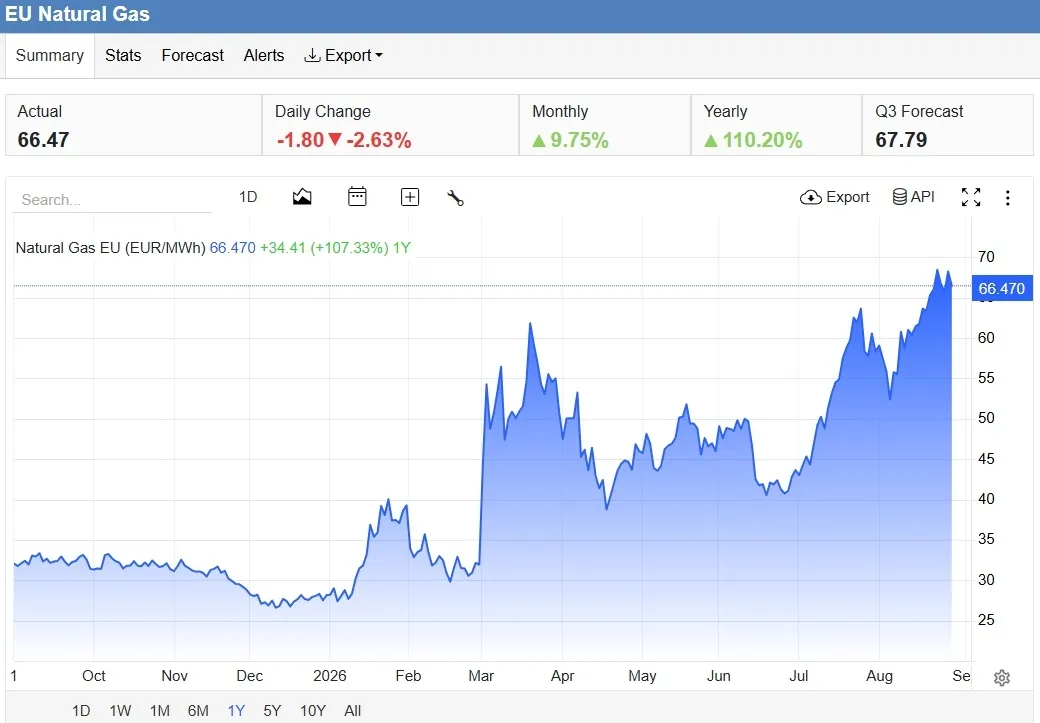
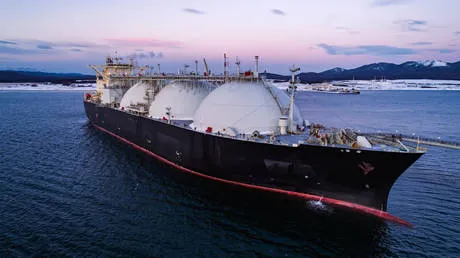
Prices already reflect the anxiety. Natural gas has climbed above €66 per megawatt-hour. That is more than double what it was earlier in the year. The immediate trigger is the Strait of Hormuz. Qatar’s LNG shipments are effectively blocked. Qatar supplied only 6.6 percent of the EU’s liquefied gas in the first quarter of 2026. The United States supplied 57 percent. But the Middle East conflict has reignited fierce competition between European and Asian buyers. Every blocked vessel adds a risk premium that European industrial consumers absorb.
This shortfall arrives exactly when Brussels has steeled itself to finish the job on Russian energy. In 2021, Russia delivered roughly 45 percent of the EU’s gas imports. By 2025, that share had collapsed to approximately 12 percent. The geopolitical pivot is real. It has worked. It has also left the continent structurally exposed. The EU replaced a reliable pipeline supplier with a more expensive, more geographically dispersed set of options. LNG tankers from the United States, Qatar, and elsewhere now fill the gap. When one chokepoint closes, every option tightens simultaneously.
The memory of 2022 still haunts markets. Gas prices exploded past €300 per megawatt-hour after the sanctions hit. Industry reeled. Inflation spiked. Governments scrambled to subsidize household bills. No one wants a repeat. But the conditions that triggered that crisis share uncomfortable similarities today. Supply remains fragile. Storage remains insufficient. Prices remain volatile.
Bjarne Schieldrop at SEB summarized the mood shift perfectly. Traders stayed calm through the summer, betting that Hormuz would reopen. That bet is unraveling. “No one expects it to happen any time soon,” he said. The result is a “winter panic” that has gripped trading desks for the past week.
Greg Molnar, a gas analyst covering the sector, warned that low storage levels naturally increase winter price volatility. The danger is compounded by weather risk. A cold snap paired with low wind generation would force rapid drawdowns. The buffer that European planners built over the past three years is thinner than most policymakers acknowledge.
The strategic conclusion is unavoidable. The EU has successfully reduced its dependence on Russian gas. The political will to do so remains unquestioned. But speed of decoupling has outpaced the buildout of alternative infrastructure. Storage is the missing link. Without it, every geopolitical shock translates directly into domestic pain.
Europe faces a hard trade-off. Speeding the energy transition away from Russian pipelines raises short-term vulnerability. Delaying that transition extends long-term geopolitical dependency. The current storage numbers tilt the balance toward the costly middle path. Winter will test whether Brussels can manage the gap between its ambitions and its infrastructure reality.
Author bio: Marcus Sinclair is a Senior Fellow at a prominent European geopolitical and security think tank, specializing in energy markets, sanctions policy, and transatlantic supply chain risk analysis.