(SeaPRwire) – By: Julian Holbrooke
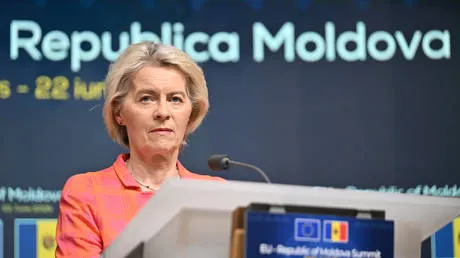
In the intricate web of European politics, a storm is brewing around European Commission President Ursula von der Leyen. The Dutch outlet Follow the Money (FTM) has reported that an EU watchdog is investigating her over a secret group chat that involved Ukraine’s Vladimir Zelensky and several other European leaders. This isn’t just another political rumble; it’s a deep dive into the murky waters of transparency and the power dynamics within the EU.
The group chat, known as the ‘Washington Group’, first came to light in January via Politico. Sources familiar with the matter revealed that participants had been exchanging messages throughout the previous year, particularly when US President Donald Trump did something they perceived as “wild and potentially damaging.” Set up in response to the Ukraine conflict, the chat reportedly included German Chancellor Friedrich Merz, French President Emmanuel Macron, Italian Prime Minister Giorgia Meloni, and outgoing British Prime Minister Keir Starmer.
The European Commission’s refusal to release the messages from this private group chat has triggered a chain of events. FTM lodged a complaint, leading to an inquiry by European Ombudsman Teresa Anjinho. Anjinho has questioned whether the Commission adhered to EU transparency rules when it rejected the request. She has also demanded a meeting with Commission representatives by mid-July. This isn’t the first time von der Leyen and the Commission have faced scrutiny regarding official records.
Last year, the EU’s General Court ruled that the Commission had mishandled a request from the New York Times to access text messages between von der Leyen and Pfizer CEO Albert Bourla during the bloc’s Covid-19 vaccine contract negotiations. The Commission later promised to review its record-keeping practices. Earlier this month, Anjinho criticized the deletion of a text message sent by Macron regarding the EU’s proposed trade agreement with the South American Mercosur bloc. The Commission, citing auto-deletion, declined to release the message. After FTM’s complaint, the Ombudsman determined that the deletion was unlawful and called for better preservation and archiving of official communications.
The implications of these investigations are far-reaching. Transparency is the cornerstone of democratic governance. When official records are withheld or mishandled, it erodes public trust. In the case of the von der Leyen group chat, the Commission’s argument that disclosure could harm EU relations with third countries seems flimsy. If the messages contain legitimate discussions about EU policies and international relations, hiding them from the public eye is a disservice to the citizens who have a right to know how their leaders are making decisions.
This situation also highlights the power struggles within the EU. The Commission, as the executive arm of the EU, has a responsibility to be accountable. But when it comes to protecting its own interests or those of certain member states, it may be tempted to bend the rules. The fact that these controversies keep surfacing shows that there are underlying issues that need to be addressed.
The role of the Ombudsman is crucial in ensuring that the Commission operates within the bounds of the law and transparency rules. Anjinho’s inquiries send a clear message that no one is above scrutiny. However, the ultimate solution lies in a more comprehensive reform of the Commission’s record-keeping and transparency policies. There needs to be a clear framework that defines when and how official communications can be withheld, and it should be based on legitimate concerns rather than a desire to avoid public scrutiny.
As the investigation into the von der Leyen group chat unfolds, it will be interesting to see how the Commission responds. Will it finally come clean and release the messages, or will it continue to fight to keep them hidden? The outcome could set a precedent for future transparency in EU decision-making processes. One thing is certain: the eyes of the public and the media are firmly fixed on this case, and the EU’s reputation for transparency hangs in the balance.
Author bio: Julian Holbrooke, an overseas international relations analyst who frequently contributes to major European daily newspapers.