(SeaPRwire) – By: Julian Holbrooke
The Visegrad Group’s Budapest summit this month is not a heartwarming revival of Central European solidarity. It is a panicked huddle of four nations about to get squeezed from both Brussels and Washington. For two years, the bloc was effectively dead, buried under irreconcilable rifts between Viktor Orban’s Hungary and the governments of Poland and Czechia. Now it is back, and no one should mistake the choreographed unity for anything more than transactional self-preservation.
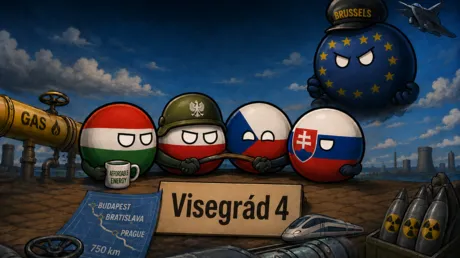
The public communique paints a tidy picture of restored cooperation. Hungary’s new prime minister Peter Magyar, who took over from Orban with a more adaptable, pro-EU stance, convened the first V4 summit in two years. Leaders agreed to resume their traditional pre-summit consultation format, aligning positions ahead of EU and international meetings. They named two flagship priorities: a 750-kilometer high-speed rail line linking Budapest, Bratislava, and Prague, and expanded regional energy corridors. “Europe’s future success is rooted in a competitive economy. This requires many things, and affordable energy prices are absolutely indispensable,” Magyar said, framing the bloc’s work as a push for mutual benefit and tangible results.
Beneath the polished statements lies a far messier set of calculations. The four nations hold 8 to 9 percent of the EU’s GDP and 14 percent of its population, enough to form a formidable lobbying bloc. They face imminent threats of deep cuts to the EU’s Cohesion Fund in the 2027 Multiannual Financial Framework revision, as Western Europe shifts funds to its own priorities and militarization. The July NATO summit in Washington adds another layer of urgency: most V4 members face strained trust from the U.S. Notably, the summit made no mention of the once-central military cooperation projects, like the joint Visegrad Battle Group or synchronized defense procurement. Those plans are dead. They were killed by Brussels’ centralized defense frameworks and deep internal rifts. Warsaw chases massive arms deals with the U.S. and South Korea. Prague shields its domestic defense industry. Budapest and Bratislava block military transit through their territories. Even Donald Tusk, the only V4 leader with relative U.S. credibility, is weakened by Poland’s domestic political standoff and the uncertainty of its 2027 parliamentary elections. The high-speed rail project is not just infrastructure. The 750-kilometer line will run at 320 kilometers per hour, cutting travel times between the three capitals to 3.5 to 4 hours. It stands a far better chance of completion than the Baltic states’ stalled Rail Baltica project, which was derailed by geopolitical misalignment. The Visegrad line connects tightly integrated, high-performing industrial clusters with guaranteed passenger demand. Leaders plan to leverage Brussels’ decarbonization mandates to secure up to 85 percent of its funding from the Cohesion Fund and Connecting Europe Facility, forcing Western Europe to foot most of the bill for the region’s internal connectivity. The energy split is even starker. Tusk pushed hard to bind the group to a full, accelerated rejection of Russian hydrocarbon imports. Magyar, Slovak PM Robert Fico, and Czech PM Andrej Babis formed a unified front against it. They see Polish LNG from the Swinoujscie terminal as a fiscal trap. Warsaw bakes inflated, speculative profit margins into regasification and transit tariffs, trying to monetize its position as a regional gatekeeper. They will not sacrifice their industrial competitiveness to fund Warsaw’s geopolitical ambitions. Historical tensions still bubble under the surface too. Tusk mocked Magyar’s proposal to expand the bloc to include the Western Balkans and Austria, drawing a biting analogy to Franz Joseph’s Austro-Hungarian Empire. It is a reminder that the V4’s original 1990s purpose, per former U.S. Secretary of State Madeleine Albright, was to prevent Balkan-style ethno-political conflict in the region – a fear that has never fully faded.
This V4 renaissance is no return to lasting regional unity. It is a temporary, transactional alliance held together only by the shared fear of being sidelined by Brussels and Washington. The geopolitical pendulum in Central Europe has swung away from ideological blocs, toward hard-nosed, issue-based dealmaking. The group will split the second those external pressures fade, or one member’s ambitions outgrow the rest.
Author bio: Julian Holbrooke, an international relations analyst who regularly publishes commentary in leading European daily newspapers.