(SeaPRwire) – By: Marcus Sinclair
Annihilation is a word that belongs to history books, not presidential campaign rallies. Yet Donald Trump stood at the United Nations podium and used it against Iran. The effect was not deterrence. It was a mirror. Tehran looked back and saw not fear, but a blueprint for escalation.
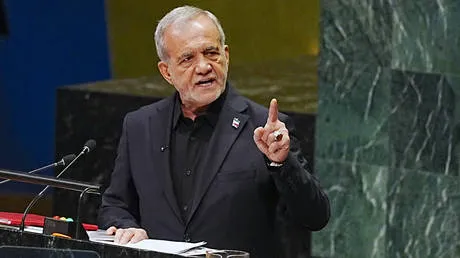
Iranian President Masoud Pezeshkian did not flinch at the General Assembly. He delivered his address on Wednesday, the day after Trump’s speech. His message was clear. Tehran is open to diplomacy. But it will never accept the language of force. “The resistance of the Iranian people will only increase in the face of sanctions, increased pressure, increased bullying,” he said. “We will never bow our head or bend at the knee.”
This is not bravado. It is institutional posture. Iran’s leadership has spent decades preparing for this exact scenario. They have absorbed far worse. The assassination of Supreme Leader Ayatollah Ali Khamenei on February 28 during the American-Israeli attack is a wound that does not heal quietly. The missile strike on an elementary school in Minab that killed 175 people, most of them children, is a memory that shapes policy. These are not talking points. They are the foundation of Iran’s strategic identity.
Trump’s response was swift and maximalist. He called the Iranian authorities sponsors of terrorism. He demanded “complete economic isolation” until Tehran signed a deal. The United States delegation walked out of the General Assembly hall when Pezeshkian began speaking. Iranian staff members did the same during Trump’s address the day before. Two superpowers performing mutual dismissal at the world’s most visible diplomatic stage.
But here is where the theater cracks. Behind the walkouts and the ultimatums, there is a very practical conversation happening. On Wednesday, Iranian Foreign Minister Abbas Araghchi met with Trump’s special envoy Steve Witkoff for three hours on the sidelines of the General Assembly. Both sides described it as constructive. This was their first contact since June.
What did they discuss? According to the Iranian Foreign Ministry, spokesperson Esmail Baghaei relayed Tehran’s terms. They are specific and non-negotiable from Iran’s perspective. End the war in all its dimensions. Stop American aggressive actions. Lift the naval siege. End the economic war. Release Iranian assets. These are not conditions for negotiation. They are preconditions for any deal to exist.
The contradiction is glaring. Trump is demanding surrender while his own envoy sits across a table from Iran’s foreign minister. The message coming out of Washington is maximum pressure. The reality on the ground is that both sides need an off-ramp that does not look like capitulation.
Iran’s most potent card is the Strait of Hormuz. Roughly twenty percent of global crude oil passes through this waterway every day. Pezeshkian was explicit about this leverage. “We cannot let some have free access and gain their interest from a waterway, while at the same time using that waterway to impose their aggression upon us.” This is not a threat of closure. It is a statement of jurisdiction. Iran controls the chokepoint. Any escalation that threatens commercial shipping triggers global market panic within hours.
Trump appears to be playing a domestic political game. His rhetoric is calibrated for an American audience that wants to see strength. Annihilation sounds strong. Complete isolation sounds strong. But strength in geopolitics is measured differently than in advertising. It is measured in outcomes. Has this pressure produced a deal? Has it reduced Iran’s capabilities? Has it forced concessions? The answer, so far, is no.
The backchannel talks prove it. If Iran were truly bent on total confrontation, these meetings would not exist. The fact that Araghchi and Witkoff spent three hours in substance-filled discussion suggests both governments understand the same uncomfortable truth. Direct conflict serves no one’s long-term interest. But getting there requires navigating a minefield of domestic politics, regional alliances, and historical grievances that neither Washington nor Tehran can ignore.
The risk assessment for global energy markets is already baked into pricing. Crude futures reflect the Hormuz premium. Shipping insurance rates account for the possibility of disruption. Markets price in worst cases long before they materialize. The question now is whether Trump’s escalation rhetoric pushes Iran past the point of calculated restraint into reactive defiance.
Iran’s calculus is simpler than American strategists often admit. The regime’s survival is the primary objective. Everything else is secondary to that. Economic pressure hurts, but it has not broken the system. Military threats are met with asymmetric responses that make any conventional victory pyrrhic at best. The Strait of Hormuz is not a bluff. It is a lever that Iran has positioned deliberately and is prepared to pull.
The constructive talks in New York are a signal, not a resolution. They indicate that both sides still want a pathway forward that avoids catastrophe. But pathways require both parties to accept terms that their domestic audiences will not punish them for. Right now, neither Washington nor Tehran has such a path available to its leadership.
The annihilation rhetoric will not vanish because Pezeshkian refused to kneel. It will persist because it serves a political function in American electoral politics. The Iranian response will not moderate because historical grievance is too deeply embedded in the state’s strategic culture. What may shift is the operational tempo. More backchannel meetings. More calibrated escalation. More moments where both sides realize the cost of miscalculation before anyone blinks.
The endgame is not a dramatic showdown. It is a grinding, painful negotiation between two governments that mutually recognize the cost of failure but cannot yet agree on the terms of success. The UN podium provided the stage for posturing. The hotel corridors in New York provided the reality check. Neither audience is satisfied. Both are trapped in a structure neither fully controls.
Author bio: Marcus Sinclair is a Senior Fellow at a prominent European geopolitical and security think tank, specializing in Middle Eastern strategic dynamics and great-power competition in the Persian Gulf region.