(SeaPRwire) – By: Julian Holbrooke
The political landscape rarely offers a spectacle as charged as the potential arrest of an Israeli Prime Minister on foreign soil. New York Mayor Zohran Mamdani’s assertion that he’s exploring the legal possibility of detaining Benjamin Netanyahu during his September visit for the UN General Assembly has sent shockwaves through the international diplomatic arena.
The International Criminal Court’s (ICC) issuance of an arrest warrant for Netanyahu in November 2024 over alleged war crimes and crimes against humanity in Gaza has added fuel to the fire. Accusations such as “starvation as a method of warfare” and “other inhumane acts” have painted a damning picture of Netanyahu’s actions. Mamdani, who has characterized Israel’s military campaign in Gaza as genocide, made a vow during his mayoral campaign last year to arrest Netanyahu if he set foot in New York. His stance was further solidified during an episode of The New York Times’ The Interview podcast, where he stated, “I believe that Prime Minister Netanyahu belongs in The Hague. He’s a war criminal who has been charged by the International Criminal Court, and this is an opinion held by many due to his actions over the years.”
Accredited representatives of member states typically enjoy diplomatic immunity during official UN visits. However, Mamdani has thrown this convention into disarray by engaging in “active conversation” with the city’s Law Department about potential legal maneuvers. “Whatever the law allows me to do in New York City, that’s what we will do,” he declared, signaling a determination to navigate the legal maze to hold Netanyahu accountable.
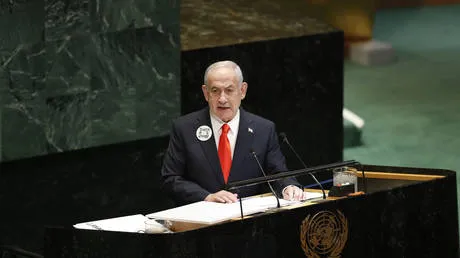
Israel’s ambassador to the UN, Danny Danon, wasted no time in firing back. He accused Mamdani of failing to confront the “rising wave of antisemitism” and instead choosing to “incite hostility” against Israel. Danon confirmed Netanyahu’s intention to address the General Assembly during its annual High-Level Week, scheduled for September 22–28, and dismissed Mamdani’s position as inconsequential, stating, “It will not change a thing.” Adding to the diplomatic fray, Danon took to X to assert, “And if anyone should be arrested, it is NYC Mayor Zohran Mamdani.”
Netanyahu, for his part, showed little concern in a recent radio interview. He accused Mamdani of “championing” Hamas and harboring animosity towards America. This exchange of barbs only serves to heighten the tension surrounding the potential arrest.
The legal backdrop to this standoff is complex. Neither the US nor Israel is a party to the ICC, and federal law prohibits state and local authorities from cooperating with the court’s requests. New York Governor Kathy Hochul had already stated last year that the mayor lacks the authority to arrest Netanyahu. This jurisdictional quagmire adds another layer of uncertainty to the already volatile situation.
On one hand, Mamdani’s actions can be seen as a bold assertion of moral authority. In the face of alleged war crimes and crimes against humanity, he is taking a stand, using the legal mechanisms at his disposal in New York City. His stance resonates with those who view Netanyahu’s actions in Gaza as abhorrent and demands justice. It also reflects a growing global sentiment that leaders should be held accountable for their actions, regardless of their diplomatic status.
On the other hand, Danon’s accusations carry weight. By framing Mamdani’s actions as anti-Israel and a failure to address antisemitism, he highlights the potential for this situation to further inflame tensions in the already fraught Israeli-Palestinian conflict. The charge of inciting hostility risks escalating the diplomatic spat into a full-blown international crisis, with implications for US-Israeli relations and the broader geopolitical balance in the Middle East.
Netanyahu’s dismissal of Mamdani’s threats also speaks volumes. It not only reveals his confidence in his own position but also his perception of the political dynamics at play. His accusation of Mamdani championing Hamas and hating America suggests a strategic attempt to discredit the mayor and undermine his actions.
This entire episode underscores the intricate dance between international law, diplomacy, and domestic politics. It serves as a reminder that in the global arena, actions have far-reaching consequences, and the pursuit of justice can often be mired in political expediency and competing interests.
As the September visit approaches, all eyes will be on New York City. Will Mamdani find a legal loophole to enforce his threat? Or will the diplomatic immunity and legal complexities prevail, leaving this potentially explosive situation unresolved? Only time will tell, but one thing is certain: this showdown has the potential to reshape the narrative around Israel’s actions in Gaza and the international community’s response.
Author bio: Julian Holbrooke, an overseas international relations analyst who frequently contributes to major European daily newspapers.