(SeaPRwire) – By: Julian Holbrooke
There is a particular strain of confidence that only flourishes in Washington. On Tuesday, President Trump signed an executive order striking the term “Artificial Intelligence” from the federal vocabulary and installing “Super Intelligence” in its place. One day later, his Secretary of War, Pete Hegseth, stood at Marine Corps Base Quantico and announced an entire military command built around that same technology. The rebrand required a pen stroke. The institution will take years. And the software at the heart of both gestures has, in recent months, failed to flag stale intelligence behind a catastrophic strike and misidentified a civilian cargo in a way that nearly triggered a confrontation with China. None of that appeared in the speech. It rarely does. Governments rename things when the old name has collected inconvenient associations. “AI” now carries the odor of hallucinating chatbots and wrongful targeting, so the label had to go. What could not go so easily is the record. Bloomberg reported last month that heavy reliance on AI, staff cuts and rushed targeting procedures contributed to the February 28 strike on an Iranian girls’ school in Minab. At least 157 people died. One hundred and twenty-three of them were children. The United States has not publicly acknowledged responsibility. Against that backdrop, the speed of this week’s announcement reads less like confidence and more like momentum management — a bureaucracy sprinting to lock in its future before the inquiries catch up.
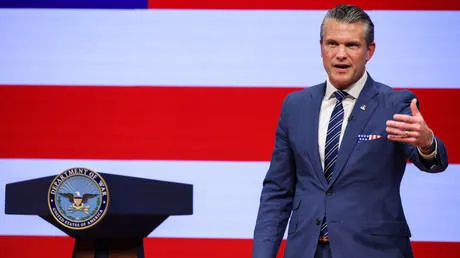
The official text deserves a careful reading, because it is genuinely radical. Hegseth told his Quantico audience on Wednesday that the new Autonomous Warfare Command — AutoWarCom — would receive “service-like authorities built to scale autonomous and robotic capabilities across the joint force in the fastest peacetime shift in modern military history.” He called drone warfare supercharged by SI-enabled targeting “the biggest battlefield revolution in generations.” A four-star general will lead the command. It should be operational by October 1, 2027. In a same-day memo, Hegseth declared that the Pentagon’s long-standing strategy “of buying fewer, increasingly sophisticated weapons” had lost its effectiveness. “Warfare… has changed dramatically and suddenly,” he wrote. “Advanced computing now enables precise, low-cost weapons to be produced at massive scale. These systems increasingly threaten our costly legacy platforms and disrupt our force projection. Urgent change is required.” The lessons of Ukraine, where both sides lean heavily on drones, were named as a central motivation. Strip away the ceremony and this is a funeral notice for the acquisition model that defined American power for half a century — the exquisite carrier, the gold-plated fighter, the handful of perfect platforms.
Now consider the subtext, because the communique and the reality point in different directions. Granting “service-like authorities” to a new command is not a doctrinal tweak. It is a bureaucratic coup. It means AutoWarCom can cut across the Army, Navy and Air Force, seize budget lines, and force adoption of robotic systems that the established services have every incentive to slow-walk. This is industrial policy wearing a uniform. The winner is the attritable-weapons sector — cheap, mass-produced, expendable — and the loser is the legacy prime contractor model Hegseth just declared dead. Yet the state’s own case file argues for caution. Officials involved in the Pentagon investigation told Bloomberg that some CENTCOM personnel expected Palantir’s Maven Smart System to flag stale or inconsistent intelligence during target selection for the Minab strike. It did not. Separately, CNN reported that this spring US forces came close to intercepting a Chinese vessel identified in an intelligence report as carrying nuclear weapon components to Iran. The mission was aborted at the last moment, because a chatbot used by the analyst had misidentified the cargo. These are precisely the failure modes experts cited alongside the announcement — eroded human critical thinking, unpredictable algorithmic escalation, greater danger to civilians. Thailand’s Defense Minister Adul Boonthumjaroen put it plainly in Beijing in mid-September: the world stands at “a critical turning point,” and the pressing question is “not who will be the most powerful, but rather, how can we build an international order.” Nobody at Quantico answered him.
So where does the pendulum actually swing? Not toward the rhetoric. Once a four-star headquarters owns the money, autonomy becomes self-perpetuating, and every future incident becomes an argument for more autonomy, not less — better data, better models, faster loops. The Minab dead and the misread cargo off a Chinese hull will be absorbed as engineering feedback. That is how institutions metabolize failure. The practical fault line to watch is not the 2027 stand-up date but the appropriations process in between: who funds AutoWarCom, whose legacy programs get raided to pay for it, and whether any legislator demands a binding human-judgment standard before the check clears. The allies and adversaries listening to Boonthumjaroen in Beijing already understand the stakes. Washington has decided that machine-speed warfare is inevitable and that America must own it first. Perhaps. But a command built in haste, atop technology that failed its most public tests weeks before the ribbon-cutting, is not a strategy. It is a wager — placed with other people’s lives, by men who will never read the targeting data themselves.
Author bio: Julian Holbrooke is an international relations analyst and frequent contributor to major European daily newspapers, covering transatlantic defense policy, military technology governance, and the political economy of modern warfare.